

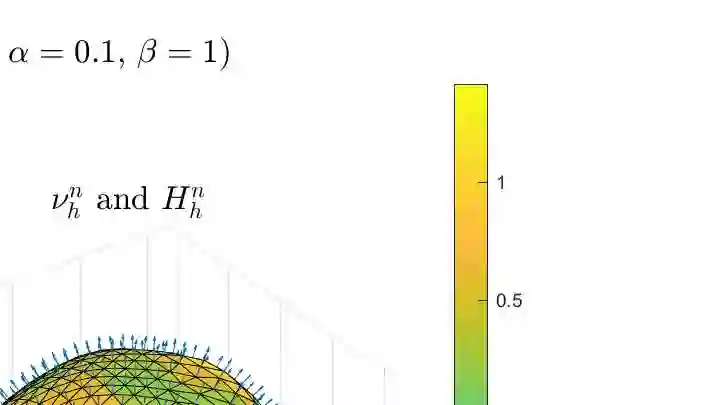
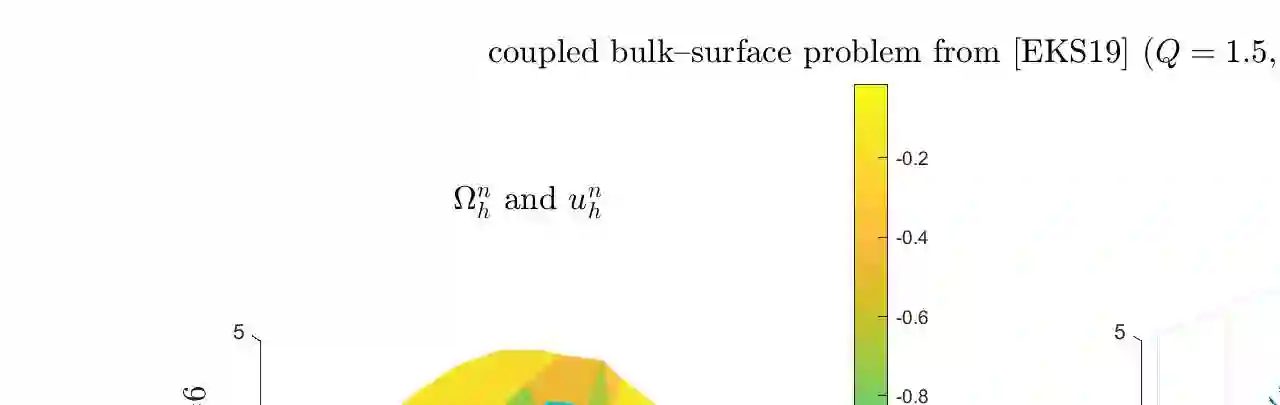
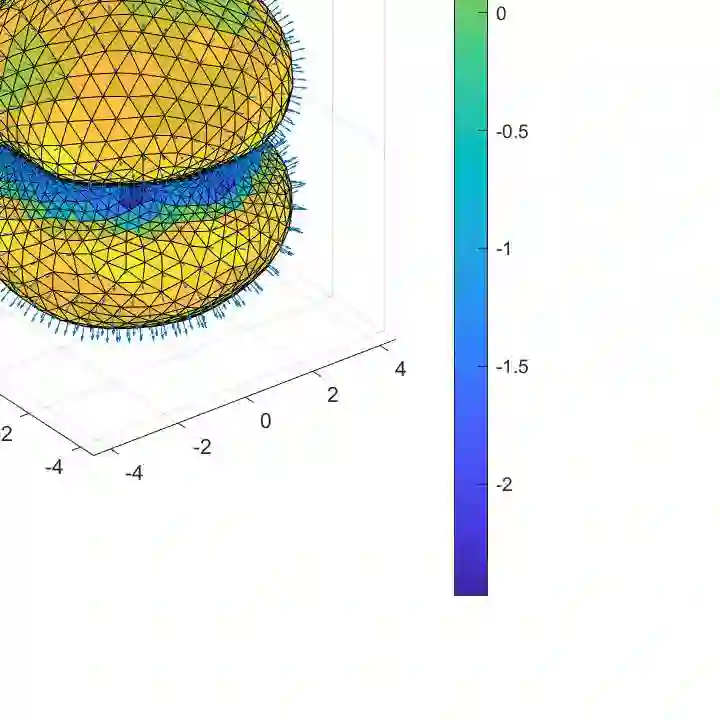
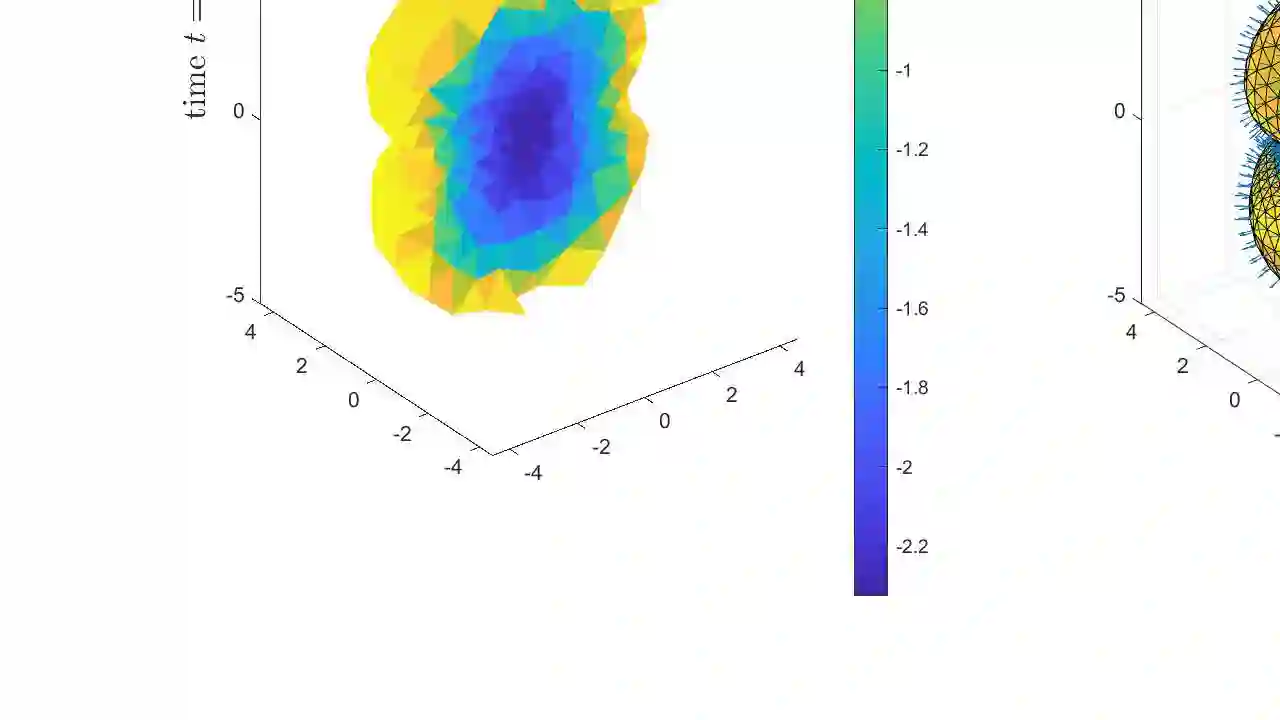
This paper studies an evolving bulk--surface finite element method for a model of tissue growth, which is a modification of the model of Eyles, King and Styles (2019). The model couples a Poisson equation on the domain with a forced mean curvature flow of the free boundary, with nontrivial bulk--surface coupling in both the velocity law of the evolving surface and the boundary condition of the Poisson equation. The numerical method discretizes evolution equations for the mean curvature and the outer normal and it uses a harmonic extension of the surface velocity into the bulk. The discretization admits a convergence analysis in the case of continuous finite elements of polynomial degree at least two. The stability of the discretized bulk--surface coupling is a major concern. The error analysis combines stability estimates and consistency estimates to yield optimal-order $H^1$-norm error bounds for the computed tissue pressure and for the surface position, velocity, normal vector and mean curvature. Numerical experiments illustrate and complement the theoretical results.
翻译:本文研究了一种用于组织生长模型的演化体-表面有限元方法,该模型是Eyles、King和Styles(2019)模型的改进形式。模型将区域上的泊松方程与自由边界受迫平均曲率流相耦合,在演化表面的速度律和泊松方程的边界条件中均存在非平凡的体-表面耦合。数值方法对平均曲率和外法向量的演化方程进行离散化,并采用表面速度到体区域的调和延拓。该离散化方法在多项式次数至少为二次的连续有限元情形下具备收敛性分析基础。离散化体-表面耦合的稳定性是关键问题。误差分析通过结合稳定性估计与相容性估计,为计算所得组织压力、表面位置、速度、法向量及平均曲率建立了最优阶$H^1$范数误差界。数值实验验证并补充了理论结果。




相关内容




 微信扫码咨询专知VIP会员