

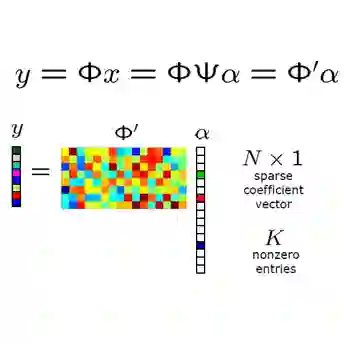
Compressed sensing combines the power of convex optimization techniques with a sparsity-inducing prior on the signal space to solve an underdetermined system of equations. For many problems, the sparsifying dictionary is not directly given, nor its existence can be assumed. Besides, the sensing matrix can change across different scenarios. Addressing these issues requires solving a sparse representation learning problem, namely dictionary learning, taking into account the epistemic uncertainty of the learned dictionaries and, finally, jointly learning sparse representations and reconstructions under varying sensing matrix conditions. We address both concerns by proposing a variant of the LISTA architecture. First, we introduce Augmented Dictionary Learning ISTA (A-DLISTA), which incorporates an augmentation module to adapt parameters to the current measurement setup. Then, we propose to learn a distribution over dictionaries via a variational approach, dubbed Variational Learning ISTA (VLISTA). VLISTA exploits A-DLISTA as the likelihood model and approximates a posterior distribution over the dictionaries as part of an unfolded LISTA-based recovery algorithm. As a result, VLISTA provides a probabilistic way to jointly learn the dictionary distribution and the reconstruction algorithm with varying sensing matrices. We provide theoretical and experimental support for our architecture and show that our model learns calibrated uncertainties.
翻译:压缩感知结合凸优化技术的力量与信号空间上的稀疏诱导先验,以求解欠定方程组。对于许多问题,稀疏化字典并非直接给定,其存在性也无法假设。此外,感知矩阵可能随不同场景而变化。解决这些问题需要求解稀疏表示学习问题,即字典学习,同时考虑学习字典的认知不确定性,并最终在变化的感知矩阵条件下联合学习稀疏表示与重建。我们通过提出一种LISTA架构的变体来同时应对这两个问题。首先,我们引入增强字典学习ISTA(A-DLISTA),它包含一个增强模块以使参数适应当前测量设置。接着,我们提出通过变分方法学习字典上的分布,称为变分学习ISTA(VLISTA)。VLISTA利用A-DLISTA作为似然模型,并在基于展开的LISTA重建算法中近似字典的后验分布。因此,VLISTA提供了一种概率化方法,可在变化的感知矩阵下联合学习字典分布与重建算法。我们为所提架构提供了理论与实验支持,并证明我们的模型能够学习到经过校准的不确定性。




相关内容



 微信扫码咨询专知VIP会员