

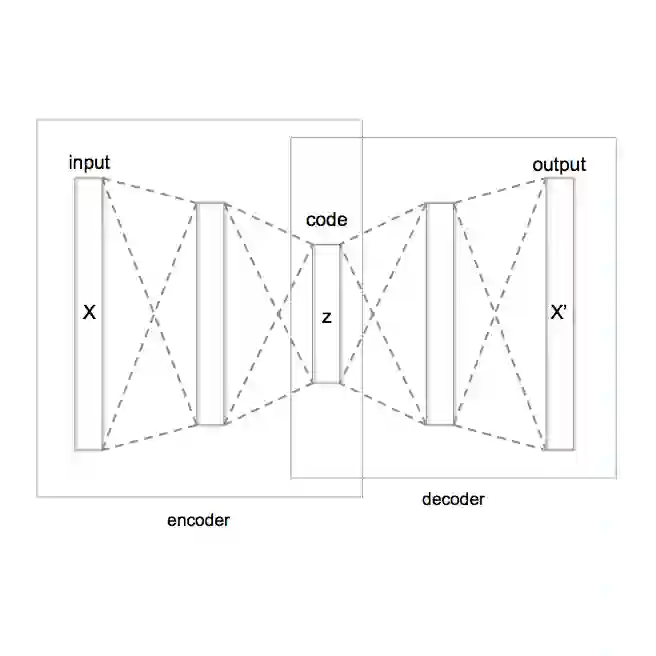
Unsupervised learning with functional data is an emerging paradigm of machine learning research with applications to computer vision, climate modeling and physical systems. A natural way of modeling functional data is by learning operators between infinite dimensional spaces, leading to discretization invariant representations that scale independently of the sample grid resolution. Here we present Variational Autoencoding Neural Operators (VANO), a general strategy for making a large class of operator learning architectures act as variational autoencoders. For this purpose, we provide a novel rigorous mathematical formulation of the variational objective in function spaces for training. VANO first maps an input function to a distribution over a latent space using a parametric encoder and then decodes a sample from the latent distribution to reconstruct the input, as in classic variational autoencoders. We test VANO with different model set-ups and architecture choices for a variety of benchmarks. We start from a simple Gaussian random field where we can analytically track what the model learns and progressively transition to more challenging benchmarks including modeling phase separation in Cahn-Hilliard systems and real world satellite data for measuring Earth surface deformation.
翻译:无监督学习与函数数据的结合是机器学习研究的新兴范式,在计算机视觉、气候建模和物理系统中具有重要应用。对函数数据进行建模的自然方法是学习无限维空间之间的算子,从而获得离散化不变的表示,这些表示的尺度独立于样本网格分辨率。本文提出变分自编码神经算子(VANO),这是一种通用策略,可使一大类算子学习架构作为变分自编码器运行。为此,我们提出了函数空间中变分目标的新颖严谨数学公式以用于训练。VANO首先通过参数化编码器将输入函数映射到潜在空间上的分布,然后从潜在分布中解码样本以重建输入,这与经典变分自编码器一致。我们通过不同模型设置和架构选择在多个基准测试上验证了VANO。我们从简单的高斯随机场开始(其中我们能够解析地追踪模型学习的内容),并逐步过渡到更具挑战性的基准测试,包括Cahn-Hilliard系统中相分离的建模以及测量地球表面变形的真实卫星数据。




相关内容




 微信扫码咨询专知VIP会员