

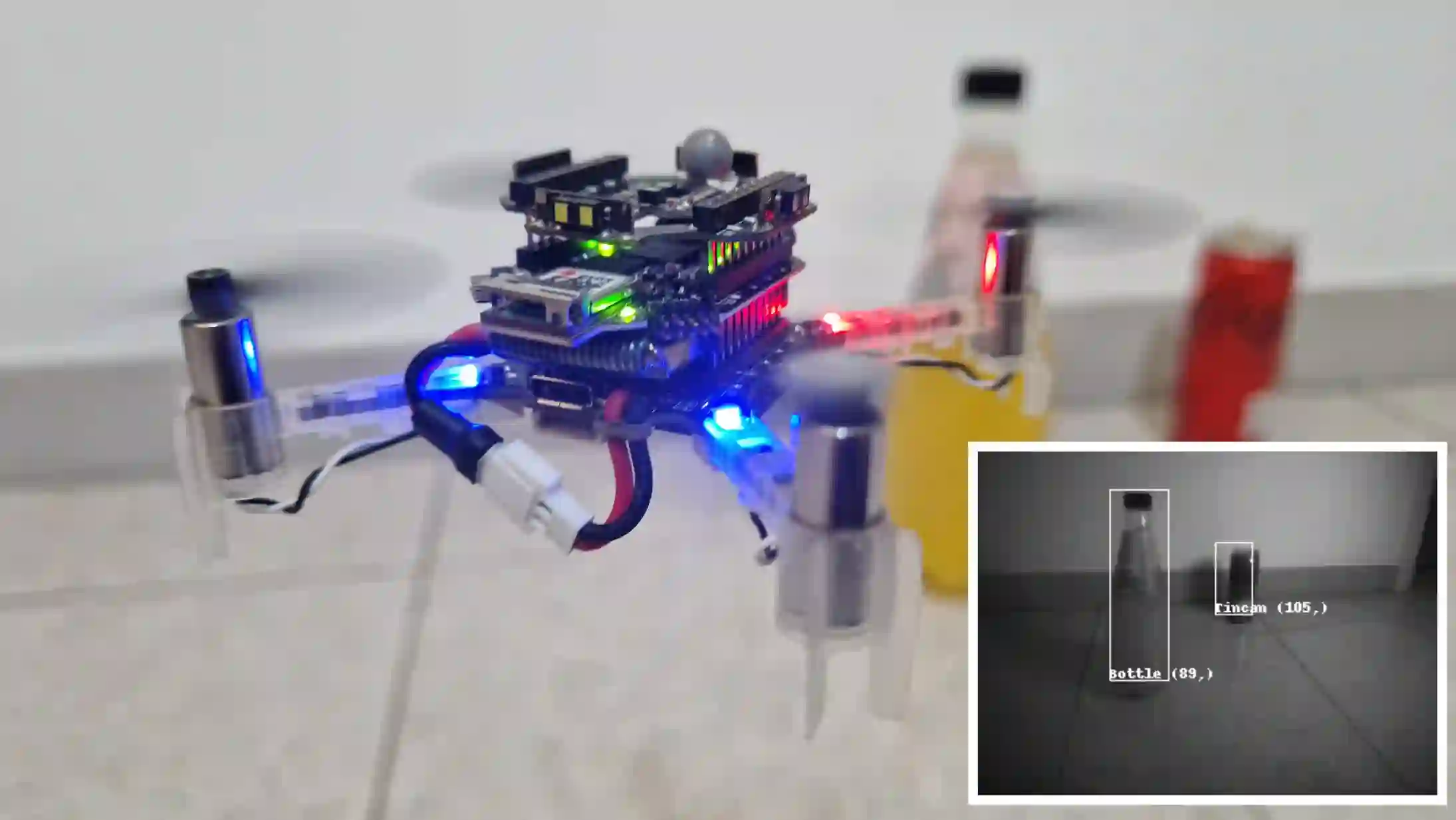
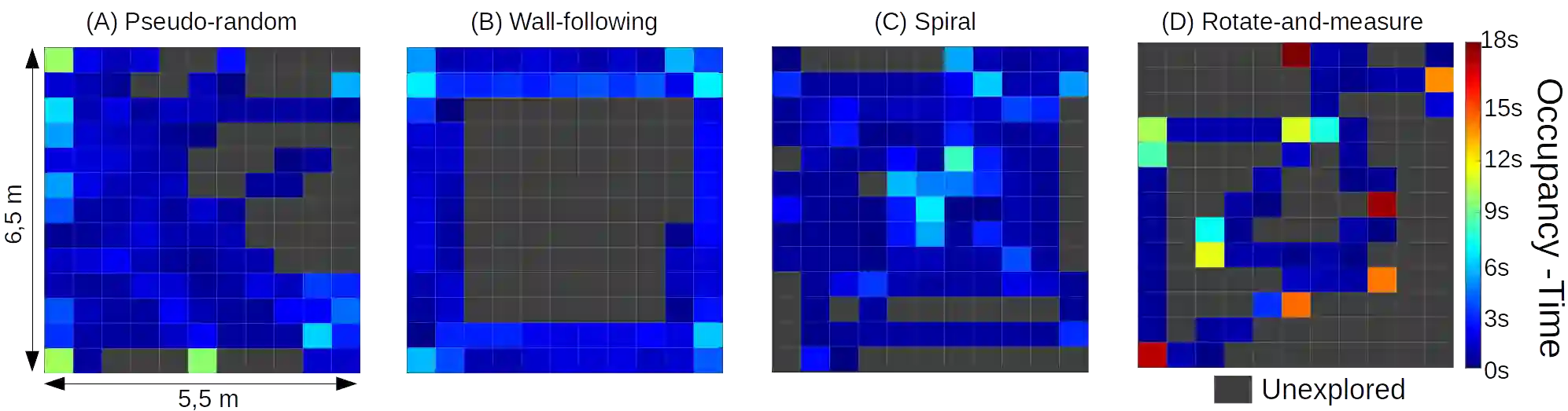
Nano-sized drones, with palm-sized form factor, are gaining relevance in the Internet-of-Things ecosystem. Achieving a high degree of autonomy for complex multi-objective missions (e.g., safe flight, exploration, object detection) is extremely challenging for the onboard chip-set due to tight size, payload (<10g), and power envelope constraints, which strictly limit both memory and computation. Our work addresses this complex problem by combining bio-inspired navigation policies, which rely on time-of-flight distance sensor data, with a vision-based convolutional neural network (CNN) for object detection. Our field-proven nano-drone is equipped with two microcontroller units (MCUs), a single-core ARM Cortex-M4 (STM32) for safe navigation and exploration policies, and a parallel ultra-low power octa-core RISC-V (GAP8) for onboard CNN inference, with a power envelope of just 134mW, including image sensors and external memories. The object detection task achieves a mean average precision of 50% (at 1.6 frame/s) on an in-field collected dataset. We compare four bio-inspired exploration policies and identify a pseudo-random policy to achieve the highest coverage area of 83% in a ~36m^2 unknown room in a 3 minutes flight. By combining the detection CNN and the exploration policy, we show an average detection rate of 90% on six target objects in a never-seen-before environment.
翻译:手掌大小的微型无人机(nano-drones)正逐渐在物联网生态系统中凸显其重要性。由于尺寸、有效载荷(<10g)和功耗包络的严格限制,其板载芯片组难以实现复杂多目标任务(如安全飞行、环境探索、目标检测)的高度自主性,这些约束同时严重限制了内存与计算能力。本研究通过将依赖飞行时间距离传感器数据的类脑导航策略与基于视觉的卷积神经网络(CNN)目标检测方法相结合,解决了这一复杂问题。我们经实地验证的微型无人机配备双微控制器单元(MCU):用于安全导航与探索策略的单核ARM Cortex-M4(STM32),以及用于板载CNN推理的并行超低功耗八核RISC-V(GAP8),其功耗包络仅为134mW(含图像传感器与外部存储器)。目标检测任务在实地采集数据集上实现了50%的平均精度均值(1.6帧/秒)。通过对比四种类脑探索策略,我们发现伪随机策略在约36m²未知房间内3分钟飞行中可达最高83%的覆盖率。将检测CNN与探索策略相结合后,我们在未见环境中的六个目标物体上实现了平均90%的检测率。







相关内容




 微信扫码咨询专知VIP会员