

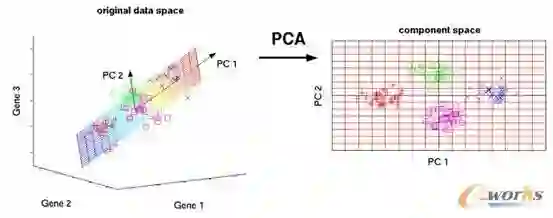
In this paper, we explore dimension reduction for functional time series. We propose a generalized dynamic functional principal component analysis (GDFPCA) which does not rely on spectral density estimation and demonstrates strong empirical performance for both stationary and nonstationary functional time series. We define the generalized dynamic functional principal components (GDFPCs) as static factor time series in a functional dynamic factor model and obtain their multivariate representation from a truncation of the functional dynamic factor model. Estimation is based on a least-squares reconstruction criterion and implemented via a two-step procedure for the coefficient vectors of the loading curves under a basis expansion. We establish mean-square consistency of the reconstructed functional time series under weak stationarity. Simulation studies show that GDFPCA performs comparably to dynamic functional principal component analysis (DFPCA) for stationary data, while providing improved reconstruction accuracy in nonstationary settings, where both DFPCA and functional principal component analysis (FPCA) deteriorate. Applications to real datasets support the empirical advantages observed in the simulations.
翻译:本文探讨函数时间序列的降维问题。我们提出了一种广义动态函数主成分分析(GDFPCA)方法,该方法不依赖于谱密度估计,并在平稳与非平稳函数时间序列中均展现出优异的实证性能。我们将广义动态函数主成分(GDFPCs)定义为函数动态因子模型中的静态因子时间序列,并通过截断函数动态因子模型获得其多元表示。估计基于最小二乘重构准则,通过基展开下对载荷曲线系数向量的两步程序实现。我们在弱平稳条件下建立了重构函数时间序列的均方一致性。模拟研究表明,对于平稳数据,GDFPCA与动态函数主成分分析(DFPCA)性能相当;而在非平稳场景下,当DFPCA与函数主成分分析(FPCA)性能退化时,GDFPCA能提供更高的重构精度。实际数据集的应用结果支持了模拟中观察到的实证优势。




相关内容


 微信扫码咨询专知VIP会员