

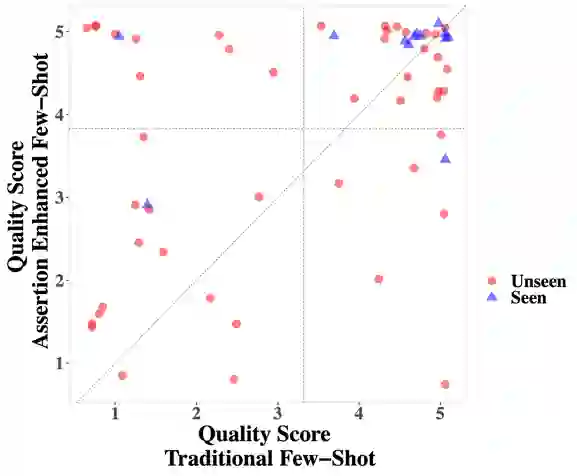
Human educators possess an intrinsic ability to anticipate and seek educational explanations from students, which drives them to pose thought-provoking questions when students cannot articulate these explanations independently. We aim to imbue Intelligent Tutoring Systems with this ability using few-shot learning capability of Large Language Models. Our work proposes a novel prompting technique, Assertion Enhanced Few-Shot Learning, to facilitate the generation of accurate, detailed oriented educational explanations. Our central hypothesis is that, in educational domain, few-shot demonstrations are necessary but not a sufficient condition for quality explanation generation. We conducted a study involving 12 in-service teachers, comparing our approach to Traditional Few-Shot Learning. The results show that Assertion Enhanced Few-Shot Learning improves explanation accuracy by 15% and yields higher-quality explanations, as evaluated by teachers. We also conduct a qualitative ablation study to factor the impact of assertions to provide educator-friendly prompting guidelines for generating explanations in their domain of interest.
翻译:人类教师天生具备预判并寻求学生教育解释的能力,这促使他们在学生无法独立阐述解释时提出启发式问题。我们旨在利用大语言模型的少样本学习能力,赋予智能辅导系统这种能力。本研究提出一种新型提示技术——断言增强的少样本学习,以促进生成准确且注重细节的教育解释。核心假设是:在教育领域,少样本示范虽是生成优质解释的必要条件,但非充分条件。我们开展了一项包含12名在职教师的研究,将本方法与传统的少样本学习进行了对比。结果表明,经教师评估,断言增强的少样本学习使解释准确率提升15%,并生成更高质量的解释。我们还进行了定性消融研究,以分解断言的影响因素,从而为教育工作者提供在其专业领域生成解释的友好型提示指南。




相关内容




 微信扫码咨询专知VIP会员