

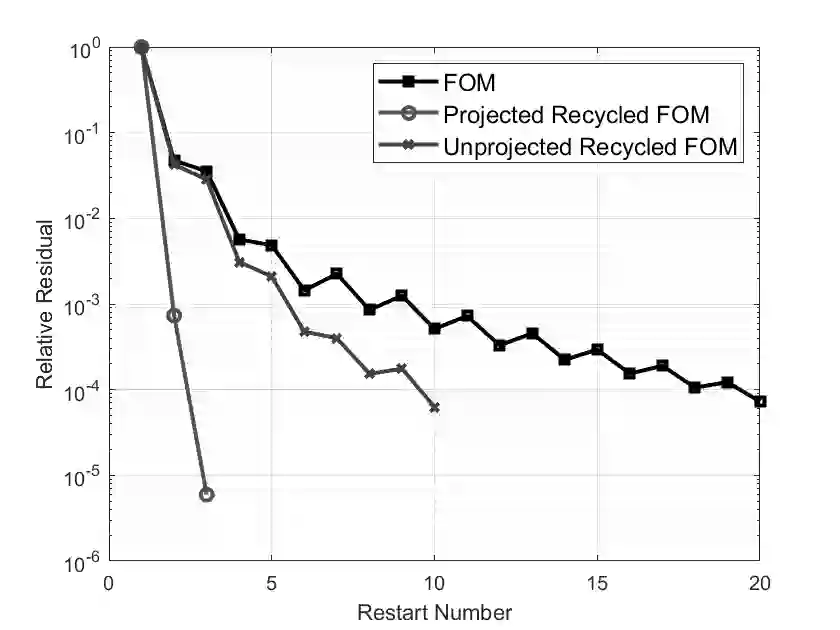
Augmented Krylov subspace methods aid in accelerating the convergence of a standard Krylov subspace method by including additional vectors in the search space. A residual projection framework based on residual (Petrov-) Galerkin constraints was presented in [Gaul et al. SIAM J. Matrix Anal. Appl 2013], and later generalised in a recent survey on subspace recycling iterative methods [Soodhalter et al. GAMM-Mitt. 2020]. The framework describes augmented Krylov subspace methods in terms of applying a standard Krylov subspace method to an appropriately projected problem. In this work we show that the projected problem has an equivalent unprojected formulation, and that viewing the framework in this way provides a similar description for the class of unprojected augmented Krylov subspace methods. We derive the first unprojected augmented Full Orthogonalization Method (FOM), and demonstrate its effectiveness as a recycling method. We then show how the R$^{3}$GMRES algorithm fits within the framework. We show that unprojected augmented short recurrence methods fit within the framework, but can only be implemented in practice under certain conditions on the augmentation subspace. We demonstrate this using the Augmented Conjugate Gradient (AugCG) algorithm as an example.
翻译:增强型Krylov子空间方法通过在搜索空间中引入额外向量,从而加速标准Krylov子空间方法的收敛。基于残差(Petrov-)Galerkin约束的残差投影框架由Gaul等人于2013年提出(SIAM J. Matrix Anal. Appl),后在Soodhalter等人于2020年发表的子空间回收迭代方法综述(GAMM-Mitt.)中得到推广。该框架将增强型Krylov子空间方法描述为将标准Krylov子空间方法应用于适当投影后的问题。本研究证明该投影问题存在等效的非投影形式,且通过此视角观察该框架可为非投影增强型Krylov子空间方法类别提供类似描述。我们首次推导出非投影增强型完全正交化方法(FOM),并验证其作为回收方法的有效性。随后展示R$^{3}$GMRES算法如何融入该框架。研究表明非投影增强型短递推方法虽能适配该框架,但实际实现需满足增强子空间的特定条件。我们以增强型共轭梯度法(AugCG)为例对此进行论证。




相关内容



 微信扫码咨询专知VIP会员