

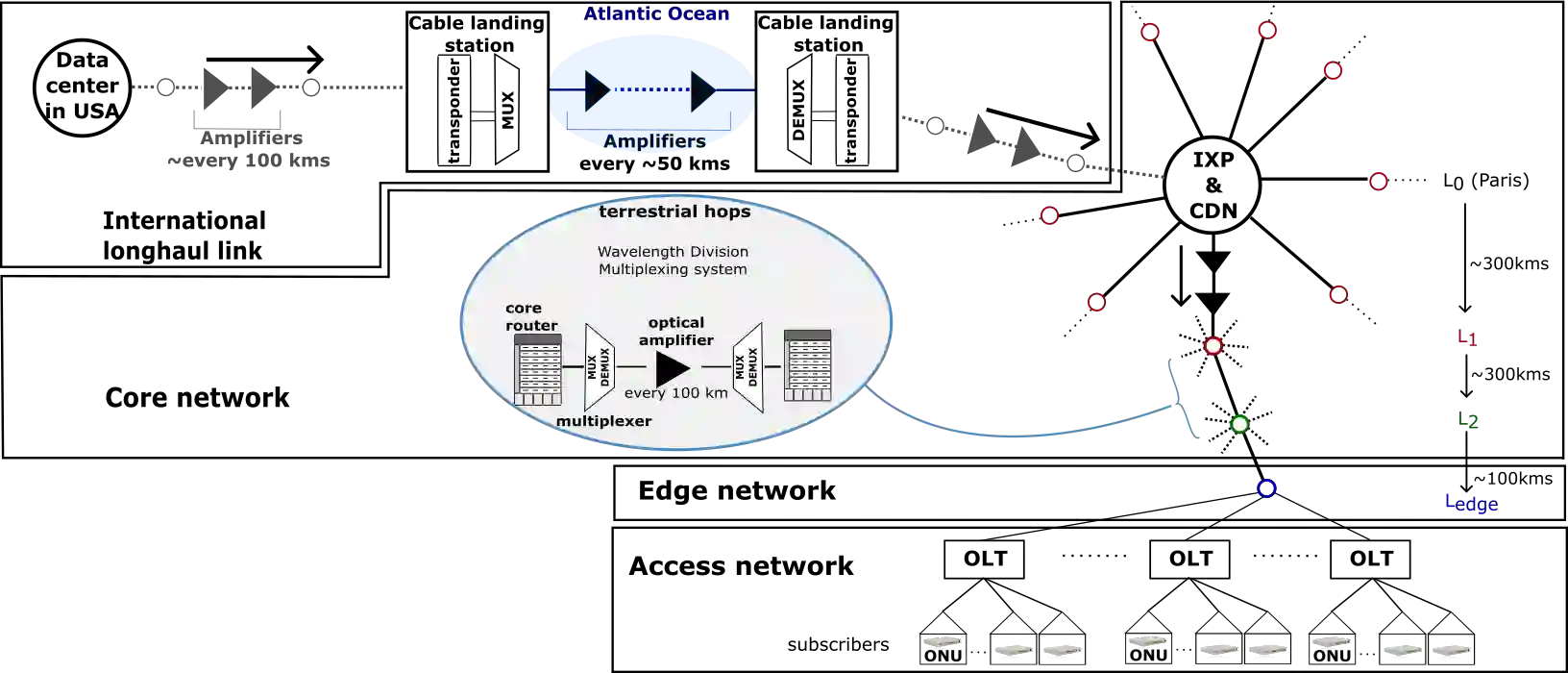
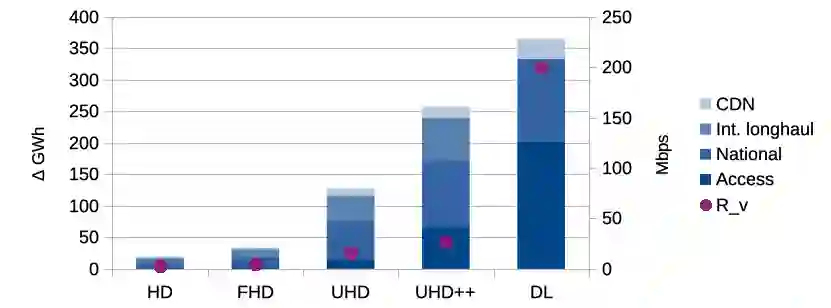
Assessing the energy consumption or carbon footprint of data distribution of video streaming services is usually carried out through energy or carbon intensity figures (in Wh or gCO2e per GB). In this paper, we first review the reasons why such approaches are likely to lead to misunderstandings and potentially to erroneous conclusions. To overcome those shortcomings, we propose a new methodology whose key idea is to consider a video streaming usage at the whole scale of a territory, and evaluate the impact of this usage on the network infrastructure. At the core of our methodology is a parametric model of a simplified network and Content Delivery Network (CDN) infrastructure, which is automatically scaled according to peak usage needs. This allows us to compare the power consumption of this infrastructure under different scenarios, ranging from a sober baseline to a generalized use of high bitrate videos. Our results show that classical efficiency indicators do not reflect the power consumption increase of more intensive Internet usage, and might even lead to misleading conclusions.
翻译:评估视频流媒体服务数据分发的能耗或碳足迹,通常通过能耗或碳强度指标(单位为Wh/GB或gCO2e/GB)进行。本文首先回顾了此类方法可能导致误解甚至错误结论的原因。为克服这些缺陷,我们提出了一种新方法论,其核心思想是在整个地区范围内考虑视频流媒体的使用情况,并评估该使用对网络基础设施的影响。该方法论的核心是一个简化网络与内容分发网络(CDN)基础设施的参数化模型,该模型可根据峰值使用需求自动扩展。这使我们能够比较不同场景下该基础设施的功耗,范围从基准保守场景到高码率视频的普遍使用场景。结果表明,经典效率指标无法反映互联网高强度使用导致的功耗增长,甚至可能引发误导性结论。







相关内容


 微信扫码咨询专知VIP会员