

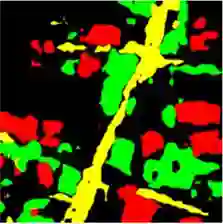
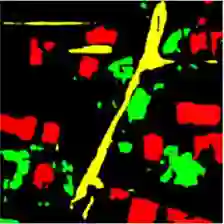
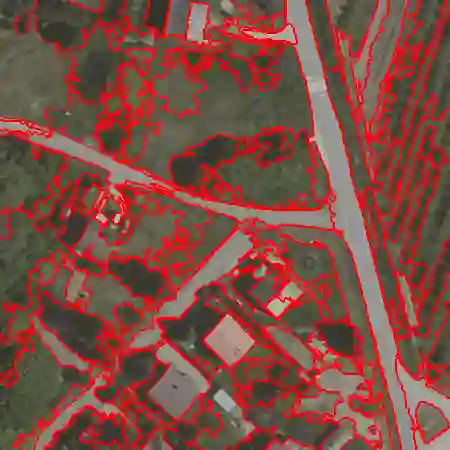
Semantic segmentation is crucial in remote sensing, where high-resolution satellite images are segmented into meaningful regions. Recent advancements in deep learning have significantly improved satellite image segmentation. However, most of these methods are typically trained in fully supervised settings that require high-quality pixel-level annotations, which are expensive and time-consuming to obtain. In this work, we present a weakly supervised learning algorithm to train semantic segmentation algorithms that only rely on query point annotations instead of full mask labels. Our proposed approach performs accurate semantic segmentation and improves efficiency by significantly reducing the cost and time required for manual annotation. Specifically, we generate superpixels and extend the query point labels into those superpixels that group similar meaningful semantics. Then, we train semantic segmentation models, supervised with images partially labeled with the superpixels pseudo-labels. We benchmark our weakly supervised training approach on an aerial image dataset and different semantic segmentation architectures, showing that we can reach competitive performance compared to fully supervised training while reducing the annotation effort.
翻译:语义分割在遥感领域至关重要,其目标是将高分辨率卫星图像分割为有意义的区域。深度学习的最新进展显著提升了卫星图像分割性能,然而,大多数方法依赖于全监督训练模式,需要昂贵且耗时的高质量像素级标注。本文提出一种弱监督学习算法,仅需查询点标注而非完整掩码标签即可训练语义分割模型。该方法在实现精确语义分割的同时,通过大幅降低人工标注成本与时间提升效率。具体而言,我们生成超像素并将查询点标签扩展至这些聚合相似语义单元的超像素中,进而利用部分标注超像素伪标签的图像训练语义分割模型。我们在航拍图像数据集及多种语义分割架构上验证了弱监督训练方法,结果表明该方法在减少标注工作量的同时,性能可媲美全监督训练。





相关内容


 微信扫码咨询专知VIP会员