

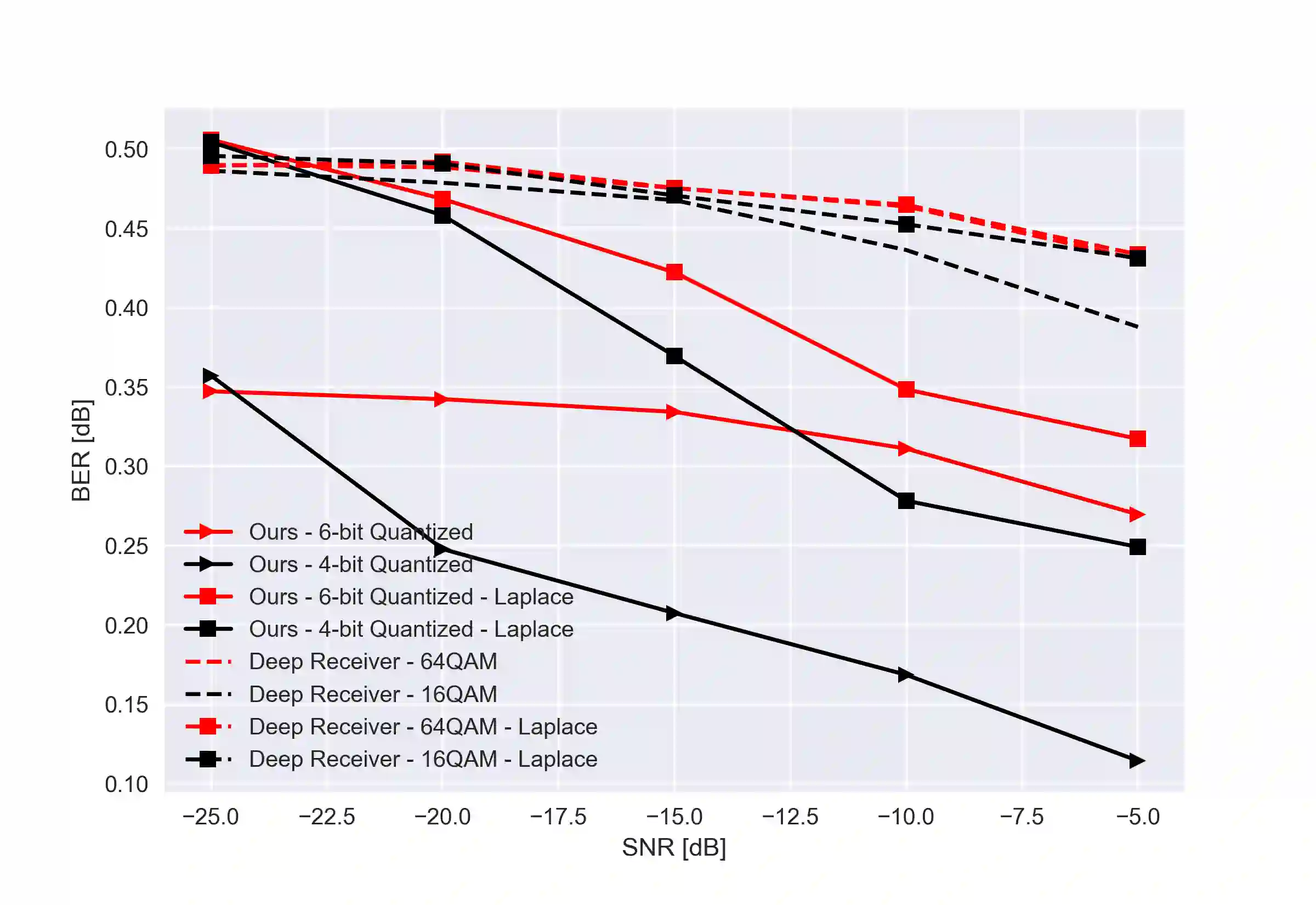
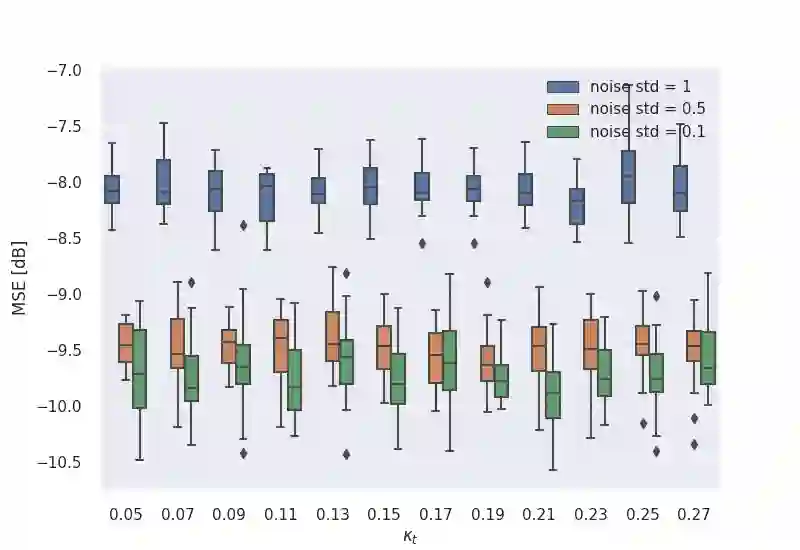
Generative AI has received significant attention among a spectrum of diverse industrial and academic domains, thanks to the magnificent results achieved from deep generative models such as generative pre-trained transformers (GPT) and diffusion models. In this paper, we explore the applications of denoising diffusion probabilistic models (DDPMs) in wireless communication systems under practical assumptions such as hardware impairments (HWI), low-SNR regime, and quantization error. Diffusion models are a new class of state-of-the-art generative models that have already showcased notable success with some of the popular examples by OpenAI and Google Brain. The intuition behind DDPM is to decompose the data generation process over small "denoising" steps. Inspired by this, we propose using denoising diffusion model-based receiver for a practical wireless communication scheme, while providing network resilience in low-SNR regimes, non-Gaussian noise, different HWI levels, and quantization error. We evaluate the reconstruction performance of our scheme in terms of bit error rate (BER) and mean-squared error (MSE). Our results show that 30% and 20% improvement in BER could be achieved compared to deep neural network (DNN)-based receivers in AWGN and non-Gaussian scenarios, respectively.
翻译:生成式人工智能在众多工业和学术领域已获得显著关注,这得益于生成式预训练Transformer(GPT)和扩散模型等深度生成模型取得的卓越成果。本文探索了去噪扩散概率模型(DDPM)在硬件损伤(HWI)、低信噪比(SNR)场景及量化误差等实际假设下的无线通信系统应用。扩散模型作为新一代先进生成模型,已通过OpenAI和Google Brain等知名案例展现出显著成功。DDPM的核心思想是将数据生成过程分解为一系列微小的"去噪"步骤。受此启发,我们提出了一种基于去噪扩散模型的接收机方案以应用于实际无线通信场景,该方案可在低SNR、非高斯噪声、不同硬件损伤等级及量化误差条件下提供网络稳健性。我们通过误码率(BER)和均方误差(MSE)评估了该方案的重构性能。结果表明,在高斯白噪声(AWGN)和非高斯场景下,与基于深度神经网络(DNN)的接收机相比,本方案在BER上分别实现了30%和20%的提升。







相关内容




 微信扫码咨询专知VIP会员