

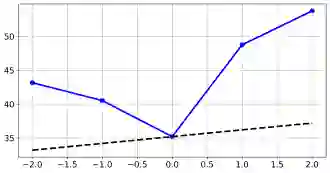
We propose a novel stereo-confidence that can be measured externally to various stereo-matching networks, offering an alternative input modality choice of the cost volume for learning-based approaches, especially in safety-critical systems. Grounded in the foundational concepts of disparity definition and the disparity plane sweep, the proposed stereo-confidence method is built upon the idea that any shift in a stereo-image pair should be updated in a corresponding amount shift in the disparity map. Based on this idea, the proposed stereo-confidence method can be summarized in three folds. 1) Using the disparity plane sweep, multiple disparity maps can be obtained and treated as a 3-D volume (predicted disparity volume), like the cost volume is constructed. 2) One of these disparity maps serves as an anchor, allowing us to define a desirable (or ideal) disparity profile at every spatial point. 3) By comparing the desirable and predicted disparity profiles, we can quantify the level of matching ambiguity between left and right images for confidence measurement. Extensive experimental results using various stereo-matching networks and datasets demonstrate that the proposed stereo-confidence method not only shows competitive performance on its own but also consistent performance improvements when it is used as an input modality for learning-based stereo-confidence methods.
翻译:本文提出了一种新颖的立体置信度度量方法,该方法可独立于各类立体匹配网络进行外部测量,为基于学习的方法(尤其是安全关键系统)提供了代价体输入模态的替代选择。该方法植根于视差定义与视差平面扫描的基本概念,其核心思想在于:立体图像对中的任何位移量变化,都应在视差图中产生对应幅度的位移更新。基于这一思想,所提出的立体置信度方法可通过三方面实现:1) 通过视差平面扫描获得多幅视差图,并将其构建为三维体数据(预测视差体),类似于代价体的构造方式;2) 选取其中一幅视差图作为锚点,据此在每一空间点定义理想视差分布;3) 通过比较理想视差分布与预测视差分布的差异,量化左右图像间的匹配歧义程度以进行置信度评估。使用不同立体匹配网络与数据集的广泛实验结果表明,本文提出的立体置信度方法不仅自身性能具有竞争力,当作为学习型立体置信度方法的输入模态时,还能持续提升模型性能表现。




相关内容



 微信扫码咨询专知VIP会员