

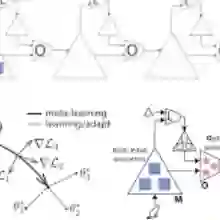
Physics-informed neural networks (PINNs) are emerging as popular mesh-free solvers for partial differential equations (PDEs). Recent extensions decompose the domain, apply different PINNs to solve the problem in each subdomain, and stitch the subdomains at the interface. Thereby, they can further alleviate the problem complexity, reduce the computational cost, and allow parallelization. However, the performance of multi-domain PINNs is sensitive to the choice of the interface conditions. While quite a few conditions have been proposed, there is no suggestion about how to select the conditions according to specific problems. To address this gap, we propose META Learning of Interface Conditions (METALIC), a simple, efficient yet powerful approach to dynamically determine appropriate interface conditions for solving a family of parametric PDEs. Specifically, we develop two contextual multi-arm bandit (MAB) models. The first one applies to the entire training course, and online updates a Gaussian process (GP) reward that given the PDE parameters and interface conditions predicts the performance. We prove a sub-linear regret bound for both UCB and Thompson sampling, which in theory guarantees the effectiveness of our MAB. The second one partitions the training into two stages, one is the stochastic phase and the other deterministic phase; we update a GP reward for each phase to enable different condition selections at the two stages to further bolster the flexibility and performance. We have shown the advantage of METALIC on four bench-mark PDE families.
翻译:物理信息神经网络(PINNs)正逐渐成为求解偏微分方程(PDEs)的流行无网格求解器。最新扩展技术通过分解求解域、在各子域中应用不同PINNs求解问题,并在界面处拼接子域,从而进一步降低问题复杂度、减少计算成本,并支持并行化。然而,多域PINNs的性能对界面条件的选择高度敏感。尽管已有多种界面条件被提出,但尚无针对具体问题选择条件的指导方法。为弥补这一不足,我们提出界面条件元学习(METALIC)——一种简单、高效且强大的方法,用于动态确定适用于参数化PDEs族求解的适当界面条件。具体而言,我们开发了两种上下文多臂老虎机(MAB)模型。第一种模型适用于整个训练过程,在线更新高斯过程(GP)奖励函数,该函数根据PDE参数和界面条件预测求解性能。我们证明了UCB和汤普森采样的次线性遗憾界,从理论上保证了MAB的有效性。第二种模型将训练分为两个阶段:随机阶段与确定性阶段;我们为每个阶段分别更新GP奖励函数,使得两阶段可采用不同条件选择策略,进一步提升灵活性与性能。我们在四个基准PDEs族上验证了METALIC的优势。




相关内容



 微信扫码咨询专知VIP会员