

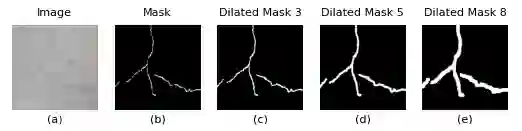
Automatically detecting or segmenting cracks in images can help in reducing the cost of maintenance or operations. Detecting, measuring and quantifying cracks for distress analysis in challenging background scenarios is a difficult task as there is no clear boundary that separates cracks from the background. Developed algorithms should handle the inherent challenges associated with data. Some of the perceptually noted challenges are color, intensity, depth, blur, motion-blur, orientation, different region of interest (ROI) for the defect, scale, illumination, complex and challenging background, etc. These variations occur across (crack inter class) and within images (crack intra-class variabilities). Overall, there is significant background (inter) and foreground (intra-class) variability. In this work, we have attempted to reduce the effect of these variations in challenging background scenarios. We have proposed a stochastic width (SW) approach to reduce the effect of these variations. Our proposed approach improves detectability and significantly reduces false positives and negatives. We have measured the performance of our algorithm objectively in terms of mean IoU, false positives and negatives and subjectively in terms of perceptual quality.
翻译:自动检测或分割图像中的裂缝有助于降低维护或运营成本。在具有挑战性的背景场景中,检测、测量和量化裂缝以进行损伤分析是一项困难的任务,因为裂缝与背景之间没有清晰的边界。开发的算法应处理数据本身固有的挑战,例如颜色、强度、深度、模糊、运动模糊、方向、缺陷的不同感兴趣区域、尺度、光照、复杂及挑战性背景等。这些变化既存在于不同图像之间(裂缝类间变异),也存在于同一图像内部(裂缝类内变异)。总体而言,存在显著的背景(类间)和前景(类内)变异性。在本研究中,我们尝试降低这些变化在挑战性背景场景中的影响,并提出了一种随机宽度方法来减少这些变异的效果。所提方法提高了可检测性,并显著减少了误报和漏报。我们通过平均交并比、误报和漏报率客观地评估了算法性能,同时基于感知质量进行了主观评估。







相关内容


 微信扫码咨询专知VIP会员