

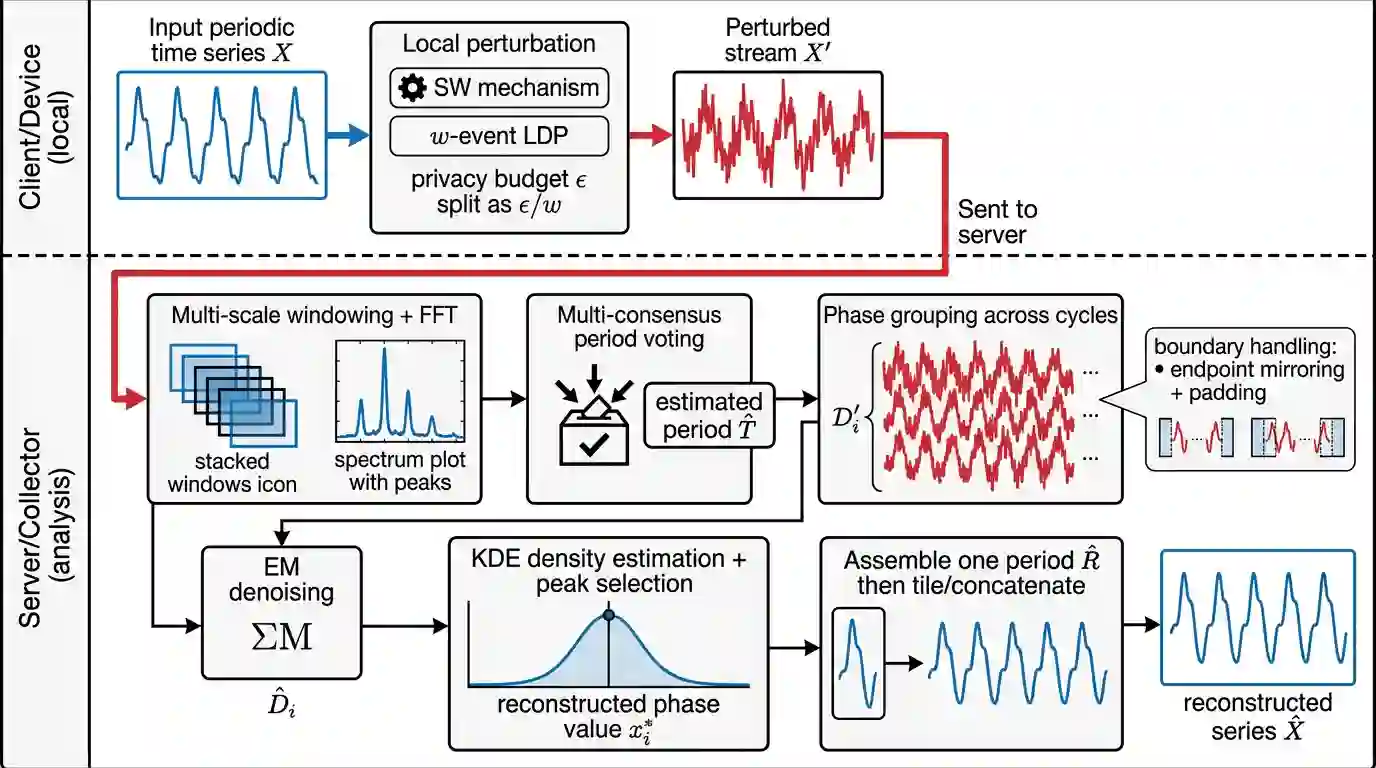
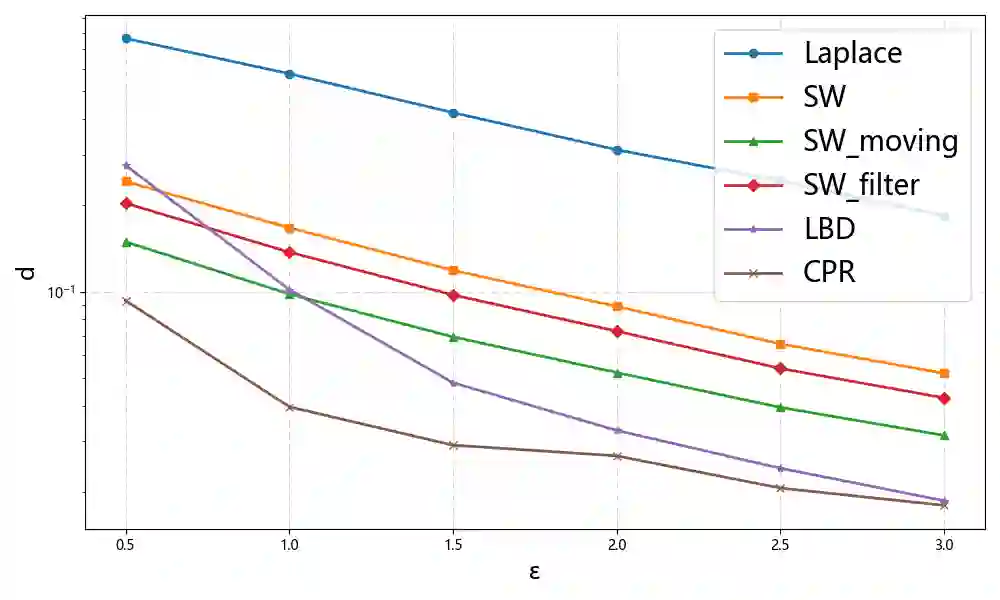
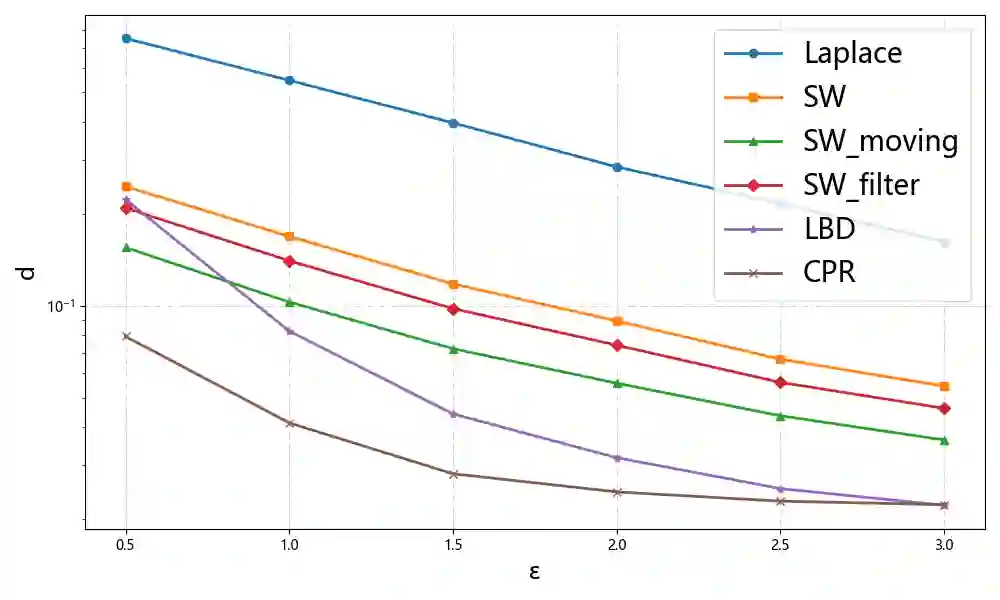
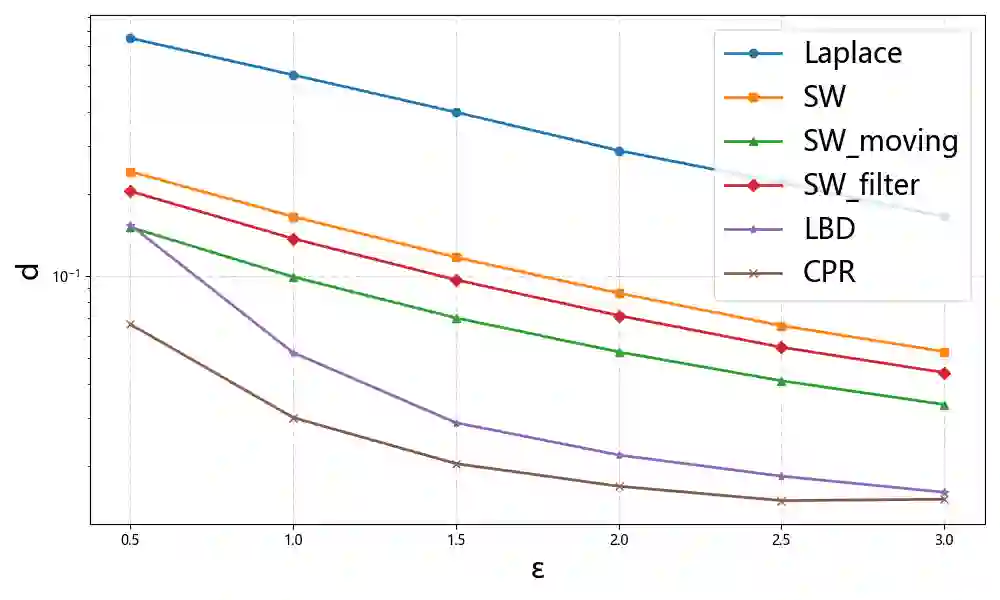
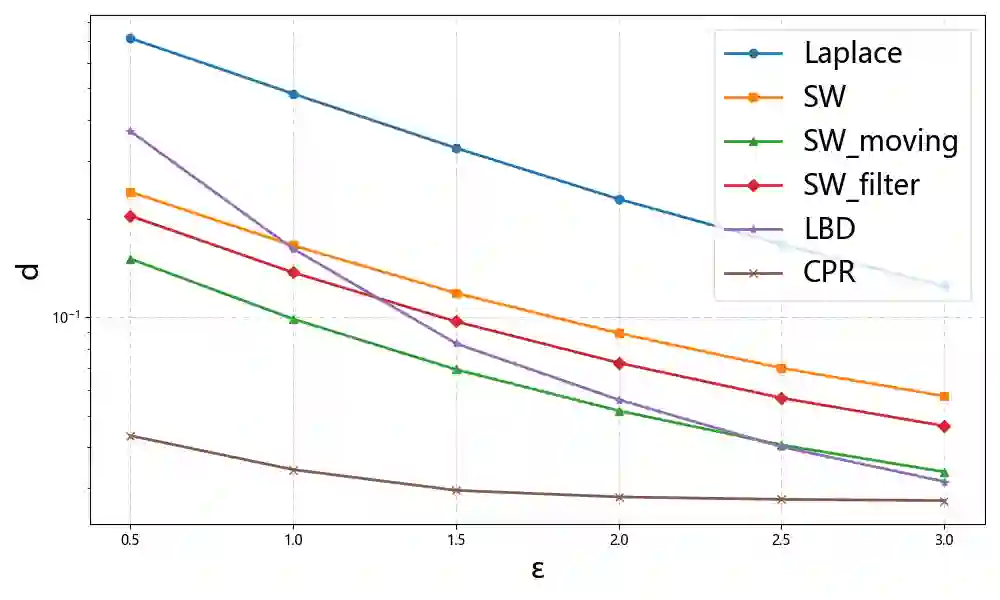
Periodic patterns are fundamental cues in multimedia signals and systems, including repetitive motion in video (e.g., gait cycles), rhythmic and pitch-related structure in audio, and recurring textures in image sequences. When such user-generated streams are collected from edge devices, local differential privacy (LDP) is appealing because it perturbs data before upload; however, the injected noise can corrupt spectral peaks and induce phase drift, making period estimation unreliable and degrading reconstruction quality. We propose \textbf{CPR} (\textit{Cycle and Phase Recovery}), a period-aware reconstruction framework for periodic time series under LDP. CPR performs multi-scale period probing and multi-consensus selection to suppress noise-induced spectral interference, then aggregates perturbed samples at matched within-cycle phase positions to stabilize phase alignment across cycles. To recover the underlying per-phase values, CPR combines EM-based denoising with kernel density estimation, improving robustness under tight privacy budgets. Experiments on two real-world periodic datasets demonstrate that CPR better preserves periodic structure and consistently achieves lower reconstruction error than representative LDP baselines, especially in the low-$ε$ regime.
翻译:周期性模式是多媒体信号与系统中的基本线索,包括视频中的重复运动(如步态周期)、音频中的节奏与音高相关结构,以及图像序列中的重复纹理。当此类用户生成的数据流从边缘设备收集时,局部差分隐私因其在上传前对数据进行扰动而具有吸引力;然而,注入的噪声会破坏频谱峰值并引发相位漂移,导致周期估计不可靠并降低重建质量。我们提出**CPR**(周期与相位恢复),一种面向局部差分隐私下周期性时间序列的周期感知重建框架。CPR通过多尺度周期探测与多共识选择抑制噪声引发的频谱干扰,进而将扰动样本在匹配的周期内相位位置进行聚合,以稳定跨周期的相位对齐。为恢复底层相位值,CPR将基于期望最大化的去噪与核密度估计相结合,从而在严格隐私预算下提升鲁棒性。在两个真实周期数据集上的实验表明,CPR能更好地保留周期性结构,并在重建误差上持续优于代表性局部差分隐私基线方法,尤其在低隐私预算(低ε)场景下表现突出。




相关内容


 微信扫码咨询专知VIP会员