

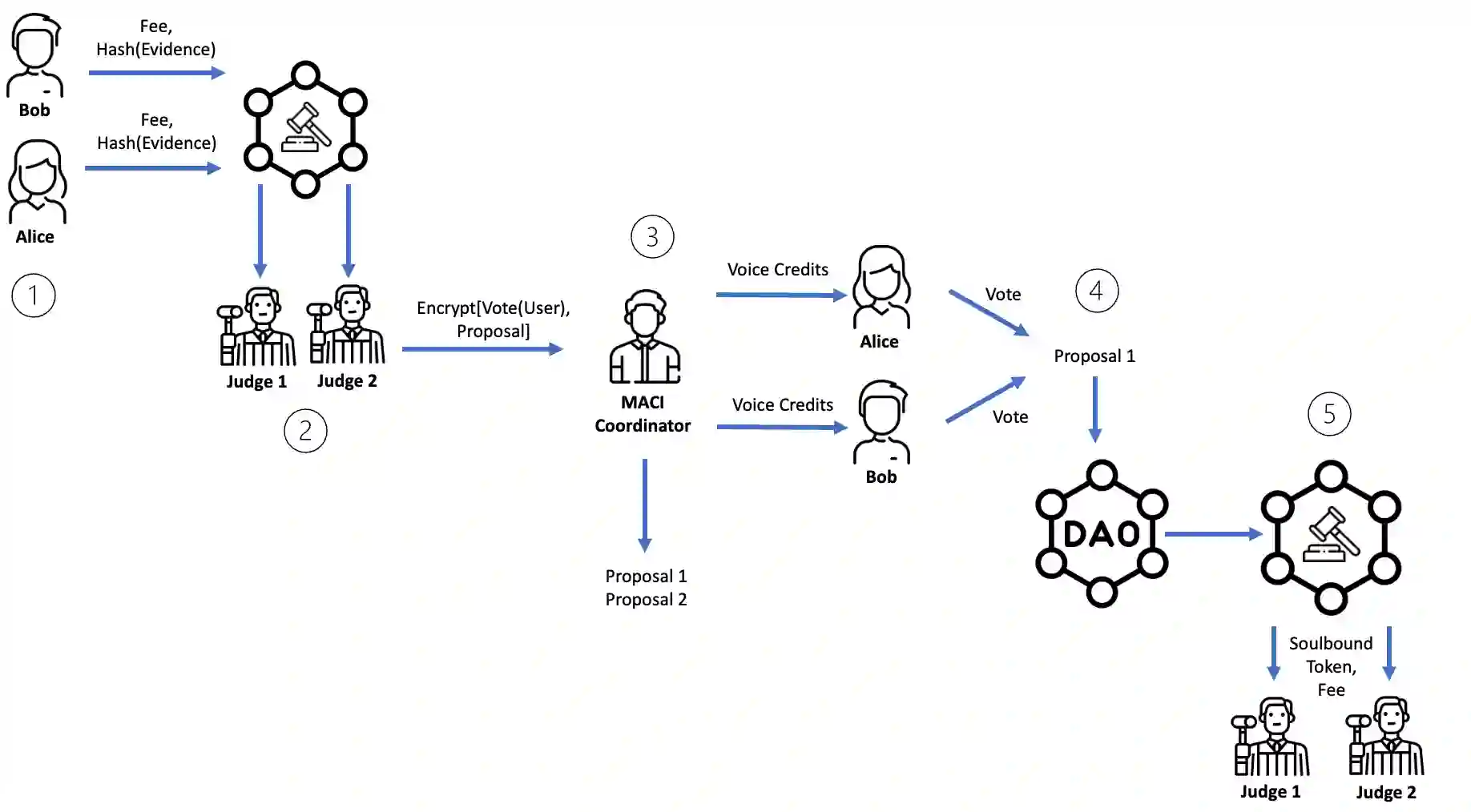
We present a new dispute resolution protocol that can be built on the Ethereum blockchain. Unlike existing applications like Kleros, privacy is ensured by design through the use of the zero-knowledge protocols Semaphore and MACI (Minimal Anti-Collusion Infrastructure), which provide, among other things, resistance to Sybil-like attacks and corruption. Differently from Kleros, dispute resolution is guaranteed despite the users having the final say. Moreover, the proposed model does not use a native token on the platform, but aims to reward stakeholders through a social incentive mechanism based on soulbound tokens, introduced by Weyl, Ohlhaver, and Buterin in 2022. Users with these tokens will be considered trustworthy and will have the ability to govern the platform. As far as we know, this is one of the first blockchain projects that seeks to introduce social governance rather than one based on economic incentives.
翻译:我们提出了一种可构建于以太坊区块链上的新型争议解决协议。与Kleros等现有应用不同,该协议通过零知识协议Semaphore和MACI(最小抗共谋基础设施)实现设计层面的隐私保障,能够抵御女巫攻击及腐败行为等威胁。与Kleros的差异在于,即便用户拥有最终裁决权,争议解决仍可得到保证。此外,所提模型无需在平台上使用原生代币,而是通过基于灵魂绑定代币(Soulbound Token)的社会激励机制对利益相关者进行奖励——该机制由Weyl、Ohlhaver和Buterin于2022年提出。持有此类代币的用户将被视为可信主体,并具备治理平台的能力。据我们所知,这是首批尝试引入社会治理范式(而非经济激励驱动治理)的区块链项目之一。




相关内容





 微信扫码咨询专知VIP会员