

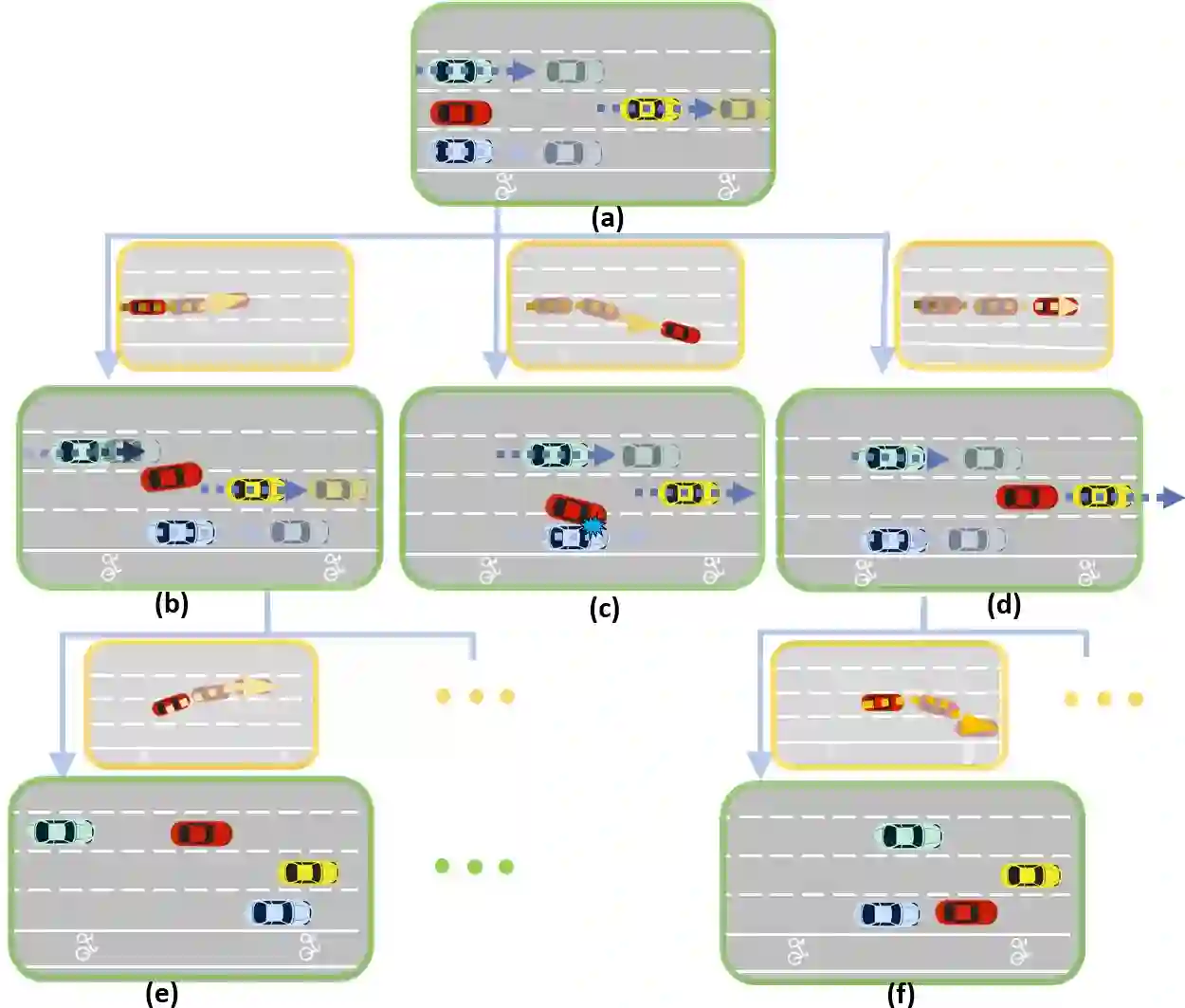
Autonomous driving holds promise for increased safety, optimized traffic management, and a new level of convenience in transportation. While model-based reinforcement learning approaches such as MuZero enables long-term planning, the exponentially increase of the number of search nodes as the tree goes deeper significantly effect the searching efficiency.To deal with this problem, in this paper we proposed the expert-guided motion-encoding tree search (EMTS) algorithm. EMTS extends the MuZero algorithm by representing possible motions with a comprehensive motion primitives latent space and incorporating expert policies toimprove the searching efficiency. The comprehensive motion primitives latent space enables EMTS to sample arbitrary trajectories instead of raw action to reduce the depth of the search tree. And the incorporation of expert policies guided the search and training phases the EMTS algorithm to enable early convergence. In the experiment section, the EMTS algorithm is compared with other four algorithms in three challenging scenarios. The experiment result verifies the effectiveness and the searching efficiency of the proposed EMTS algorithm.
翻译:自动驾驶有望提高安全性、优化交通管理,并为交通运输带来全新的便利性。尽管基于模型的强化学习方法(如MuZero)能够实现长时域规划,但随着搜索树深度增加,搜索节点数量呈指数级增长,严重影响了搜索效率。为解决这一问题,本文提出专家引导的运动编码树搜索(EMTS)算法。EMTS通过构建包含全面运动基元的潜空间来表示可能的运动,并引入专家策略以提高搜索效率。该全面的运动基元潜空间使EMTS能够采样任意轨迹而非原始动作,从而降低搜索树深度;同时,专家策略的引入引导了EMTS算法的搜索与训练阶段,实现了早期收敛。在实验部分,EMTS算法在三个具有挑战性的场景中与其他四种算法进行了比较。实验结果验证了所提EMTS算法的有效性和搜索效率。






相关内容



 微信扫码咨询专知VIP会员