

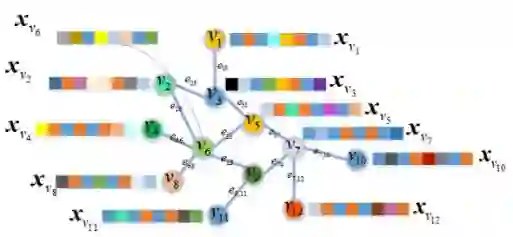
Fuzzy systems (FSs) have enjoyed wide applications in various fields, including pattern recognition, intelligent control, data mining and bioinformatics, which is attributed to the strong interpretation and learning ability. In traditional application scenarios, FSs are mainly applied to model Euclidean space data and cannot be used to handle graph data of non-Euclidean structure in nature, such as social networks and traffic route maps. Therefore, development of FS modeling method that is suitable for graph data and can retain the advantages of traditional FSs is an important research. To meet this challenge, a new type of FS for graph data modeling called Graph Fuzzy System (GFS) is proposed in this paper, where the concepts, modeling framework and construction algorithms are systematically developed. First, GFS related concepts, including graph fuzzy rule base, graph fuzzy sets and graph consequent processing unit (GCPU), are defined. A GFS modeling framework is then constructed and the antecedents and consequents of the GFS are presented and analyzed. Finally, a learning framework of GFS is proposed, in which a kernel K-prototype graph clustering (K2PGC) is proposed to develop the construction algorithm for the GFS antecedent generation, and then based on graph neural network (GNNs), consequent parameters learning algorithm is proposed for GFS. Specifically, three different versions of the GFS implementation algorithm are developed for comprehensive evaluations with experiments on various benchmark graph classification datasets. The results demonstrate that the proposed GFS inherits the advantages of both existing mainstream GNNs methods and conventional FSs methods while achieving better performance than the counterparts.
翻译:模糊系统(FSs)凭借其强大的解释性与学习能力,在模式识别、智能控制、数据挖掘及生物信息学等多个领域得到了广泛应用。在传统应用场景中,FSs主要面向欧几里得空间数据建模,难以处理本质上具有非欧几里得结构的图数据,例如社交网络和交通路线图。因此,开发适用于图数据且能保留传统FSs优势的模糊系统建模方法是一项重要研究。为应对这一挑战,本文提出了一种面向图数据建模的新型模糊系统——图模糊系统(GFS),并系统性地阐述了其概念、建模框架及构建算法。首先,定义了GFS的相关概念,包括图模糊规则库、图模糊集以及图后件处理单元(GCPU)。随后,构建了GFS建模框架,并对该系统的前件与后件进行了阐述与分析。最后,提出了GFS的学习框架:在该框架中,提出了一种核K原型图聚类(K2PGC)算法,用于开发GFS前件生成的构建算法;并基于图神经网络(GNNs),提出了GFS的后件参数学习算法。具体而言,为实现全面评估,开发了三种不同版本的GFS实现算法,并在多个基准图分类数据集上进行了实验。结果表明,所提出的GFS不仅继承了现有主流GNNs方法与传统FSs方法的优势,且在性能上优于同类方法。






相关内容




 微信扫码咨询专知VIP会员