

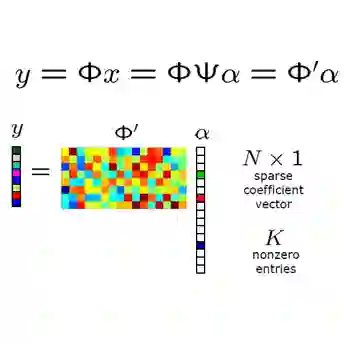
Compressive sensing (CS) reconstructs images from sub-Nyquist measurements by solving a sparsity-regularized inverse problem. Traditional CS solvers use iterative optimizers with hand crafted sparsifiers, while early data-driven methods directly learn an inverse mapping from the low-dimensional measurement space to the original image space. The latter outperforms the former, but is restrictive to a pre-defined measurement domain. More recent, deep unrolling methods combine traditional proximal gradient methods and data-driven approaches to iteratively refine an image approximation. To achieve higher accuracy, it has also been suggested to learn both the sampling matrix, and the choice of measurement vectors adaptively. Contrary to the current trend, in this work we hypothesize that a general inverse mapping from a random set of compressed measurements to the image domain exists for a given measurement basis, and can be learned. Such a model is single-shot, non-restrictive and does not parametrize the sampling process. To this end, we propose MOSAIC, a novel compressive sensing framework to reconstruct images given any random selection of measurements, sampled using a fixed basis. Motivated by the uneven distribution of information across measurements, MOSAIC incorporates an embedding technique to efficiently apply attention mechanisms on an encoded sequence of measurements, while dispensing the need to use unrolled deep networks. A range of experiments validate our proposed architecture as a promising alternative for existing CS reconstruction methods, by achieving the state-of-the-art for metrics of reconstruction accuracy on standard datasets.
翻译:压缩感知(CS)通过求解稀疏正则化逆问题,从亚奈奎斯特采样测量值中重建图像。传统CS求解器采用基于迭代优化器的手工稀疏化方法,而早期数据驱动方法则直接学习从低维测量空间到原始图像空间的逆映射。后者虽优于前者,但受限于预定义的测量域。近期,深度展开方法结合传统近端梯度算法与数据驱动方法,通过迭代细化图像近似值。为提升精度,有研究进一步提出自适应学习采样矩阵与测量向量选择。与当前趋势不同,本研究假设:对于给定测量基,存在从随机压缩测量集到图像域的通用逆映射,且该映射可被学习。此模型具有单步、非限制性特点,且无需对采样过程参数化。为此,我们提出MOSAIC——一种新型压缩感知框架,可在固定基下对任意随机测量子集实现图像重建。受测量信息分布不均匀现象的启发,MOSAIC引入嵌入技术,在编码测量序列上高效应用注意力机制,同时避免使用展开式深度网络。多组实验验证了所提架构作为现有CS重建方法有力替代方案的潜力,其在标准数据集上达到了重建精度指标的最优水平。




相关内容




 微信扫码咨询专知VIP会员