

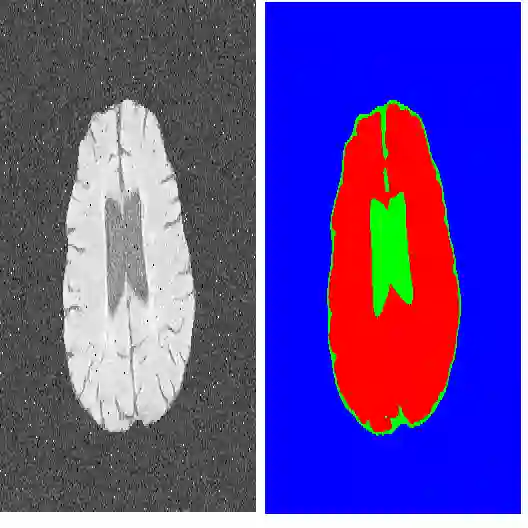
Minimum distance estimation methodology based on an empirical distribution function has been popular due to its desirable properties including robustness. Even though the statistical literature is awash with the research on the minimum distance estimation, the most of it is confined to the theoretical findings: only few statisticians conducted research on the application of the method to real world problems. Through this paper, we extend the domain of application of this methodology to various applied fields by providing a solution to a rather challenging and complicated computational problem. The problem this paper tackles is an image segmentation which has been used in various fields. We propose a novel method based on the classical minimum distance estimation theory to solve the image segmentation problem. The performance of the proposed method is then further elevated by integrating it with the ``segmenting-together" strategy. We demonstrate that the proposed method combined with the segmenting-together strategy successfully completes the segmentation problem when it is applied to the complex, real images such as magnetic resonance images.
翻译:基于经验分布函数的最小距离估计方法因其稳健性等优良性质而广受欢迎。尽管统计文献中关于最小距离估计的研究汗牛充栋,但大部分仅停留在理论层面:仅有少数统计学家将其应用于实际问题。本文通过解决一个颇具挑战且复杂的计算问题,将这一方法的应用领域拓展至多个实际场景。本文聚焦于图像分割问题——该技术已广泛应用于多个领域。我们基于经典最小距离估计理论提出了一种新型图像分割方法,并进一步通过"协同分割"策略提升了该方法的表现性能。实验证明,当该方法与协同分割策略相结合时,能够成功完成对磁共振图像等复杂真实图像的分割任务。




相关内容



 微信扫码咨询专知VIP会员