

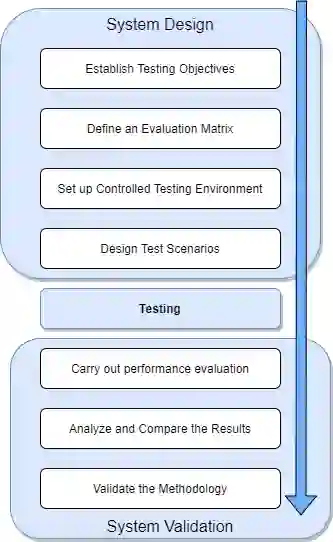
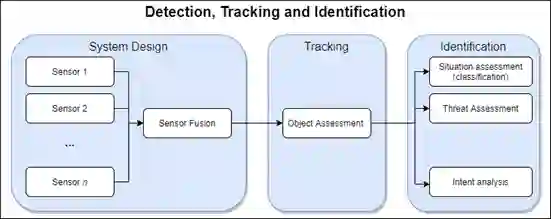
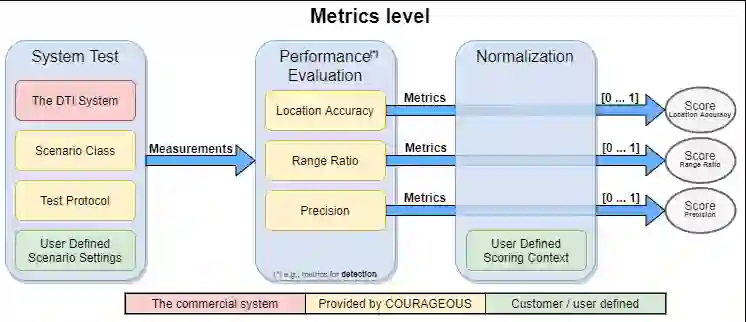
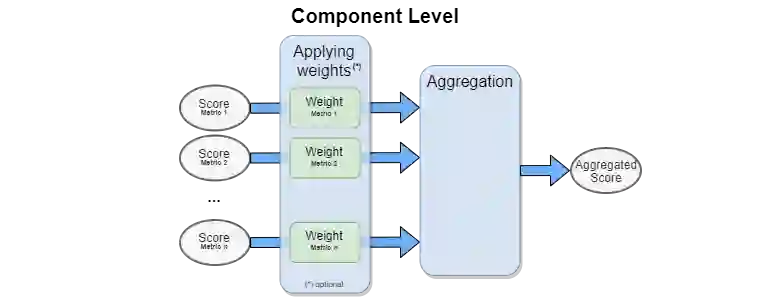
Unmanned Aerial Systems (UASs) or drones become more and more commercially available and cheap. There has been much emphasis on developing and deploying Counter-UAS systems (UASs) with Detection Tracking and Identification (DTI) solutions. However, the capabilities of these systems are hard to benchmark. Performance claims of these systems are currently not supported by evidence. In addition, no standard test methodologies are available for these DTI systems and different test methodologies make comparison of these systems hard or impossible. We report on the definition, development and verification of an objective-driven test method and corresponding comparative performance evaluation for commercial DTI solutions for C-UASs. The developed methodology is based on end-user scenarios that are operationally relevant. The test methodology is based on a generic DTI system lay-out and is detailed towards detection, tracking and identification, taking into account contextual information and end-user input. The comparative performance evaluation is developed to enable the use of the methodology in a relevant environment, thereby taking into account any potential environmental aspect that might influence DTI system performance. Validation of the work in a relevant environment has been done in three operational trials. The operational trial results show that the method allows for performance evaluation at component level (i.e., detection, tracking or identification component) and at system level (combinations of these components and integrated DTI system of system solutions).
翻译:无人航空系统(UAS)或无人机正日益商业化且成本低廉。目前,业界高度关注开发和部署集成检测、跟踪与识别(DTI)解决方案的反无人机系统(C-UAS)。然而,这些系统的性能难以进行基准测试,其性能声明缺乏证据支持。此外,目前尚无针对这类DTI系统的标准化测试方法,不同测试方法的差异导致系统间的比较变得困难甚至不可行。本文报告了一种面向商用C-UAS DTI解决方案的客观驱动测试方法及其对应的对比性能评估的定义、开发与验证过程。该方法基于与作战场景相关的终端用户情境,并依据通用DTI系统架构进行细化,涵盖检测、跟踪与识别功能,同时纳入情境信息与终端用户输入。对比性能评估框架的设计旨在支持在相关环境中应用该方法,并充分考虑可能影响DTI系统性能的各类环境因素。通过三次作战试验对相关环境下的工作进行了验证。试验结果表明,该方法支持在组件级(即检测、跟踪或识别模块)和系统级(上述模块的组合及集成式DTI系统解决方案)两个层面进行性能评估。




相关内容





 微信扫码咨询专知VIP会员