

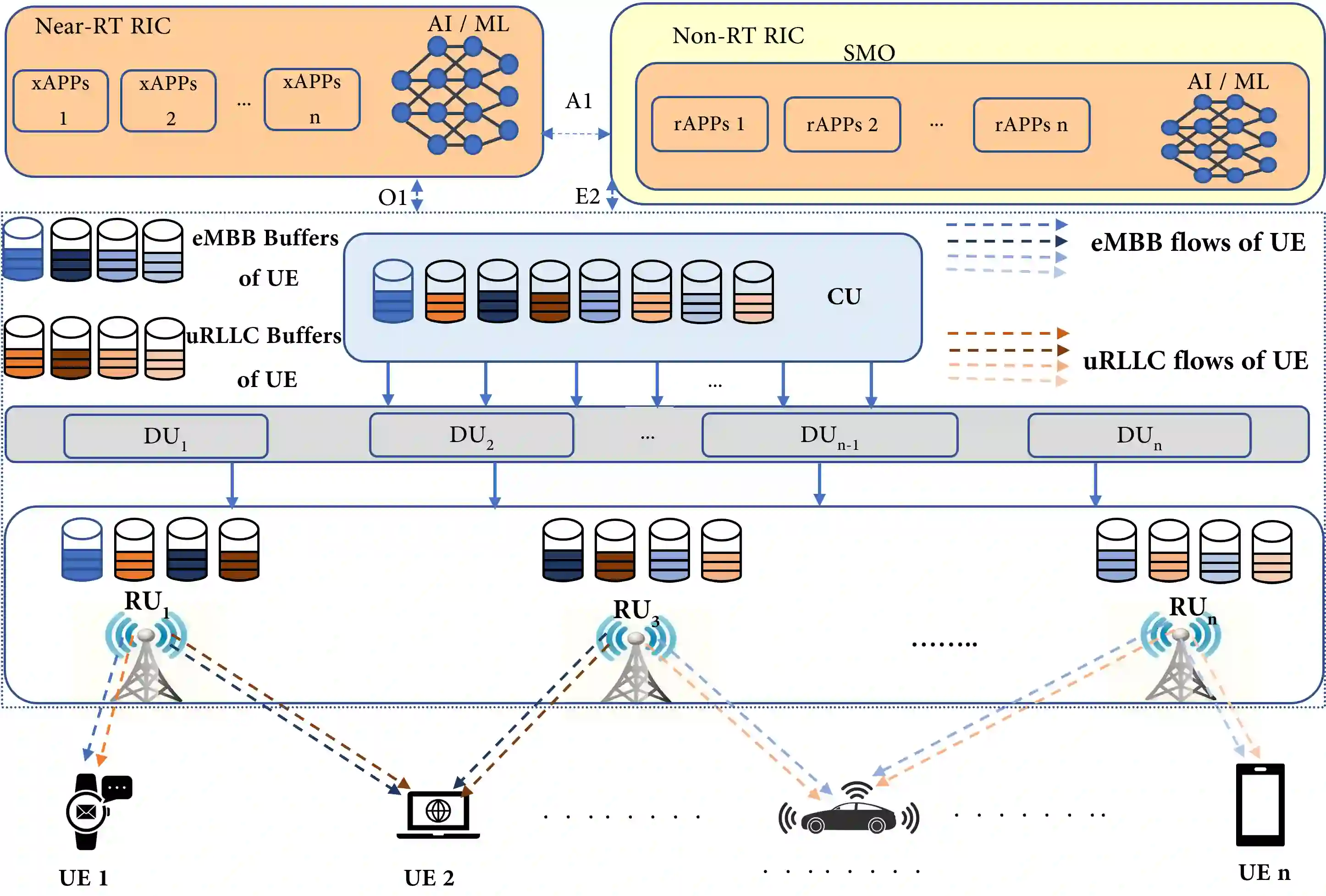
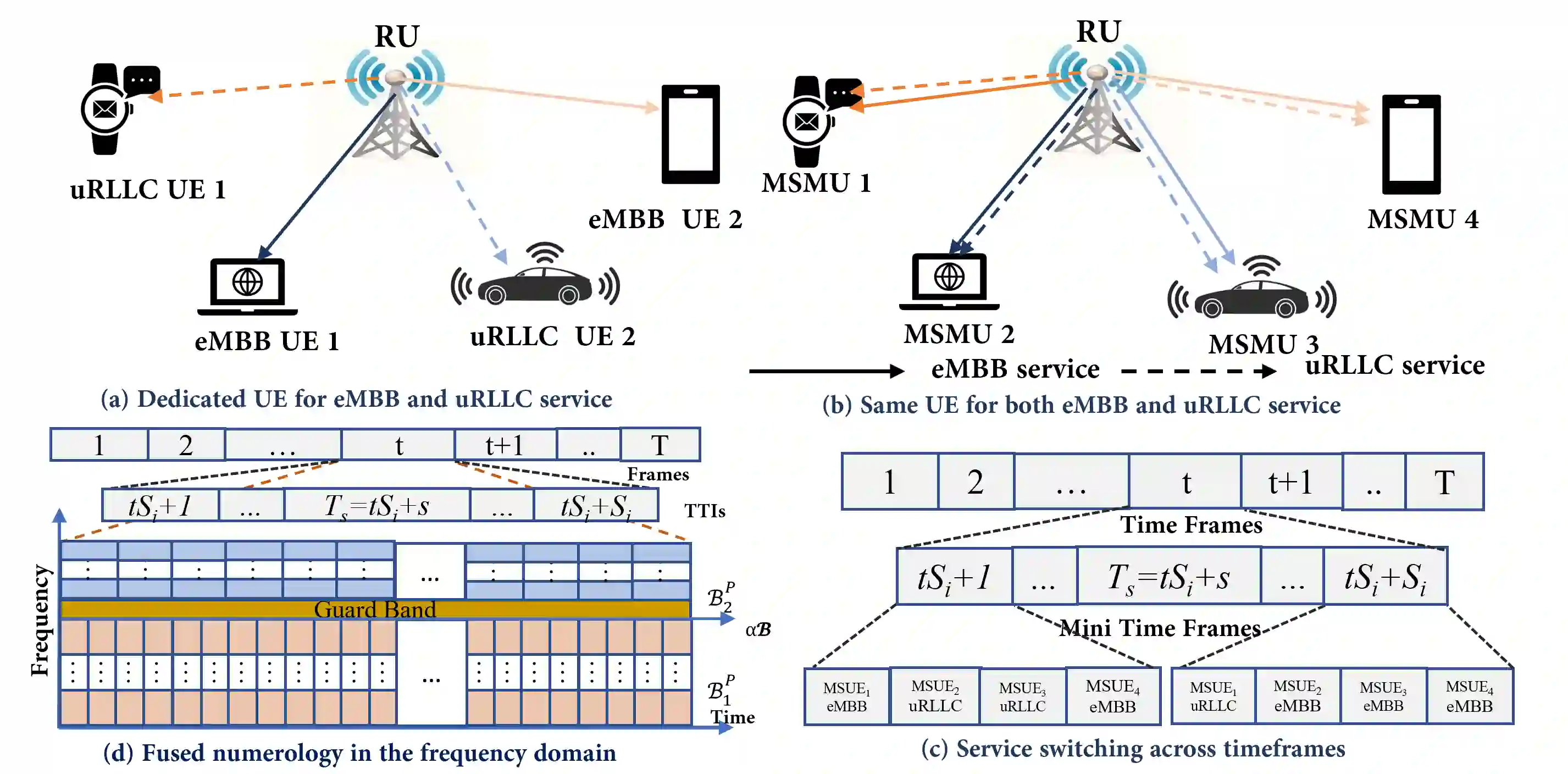
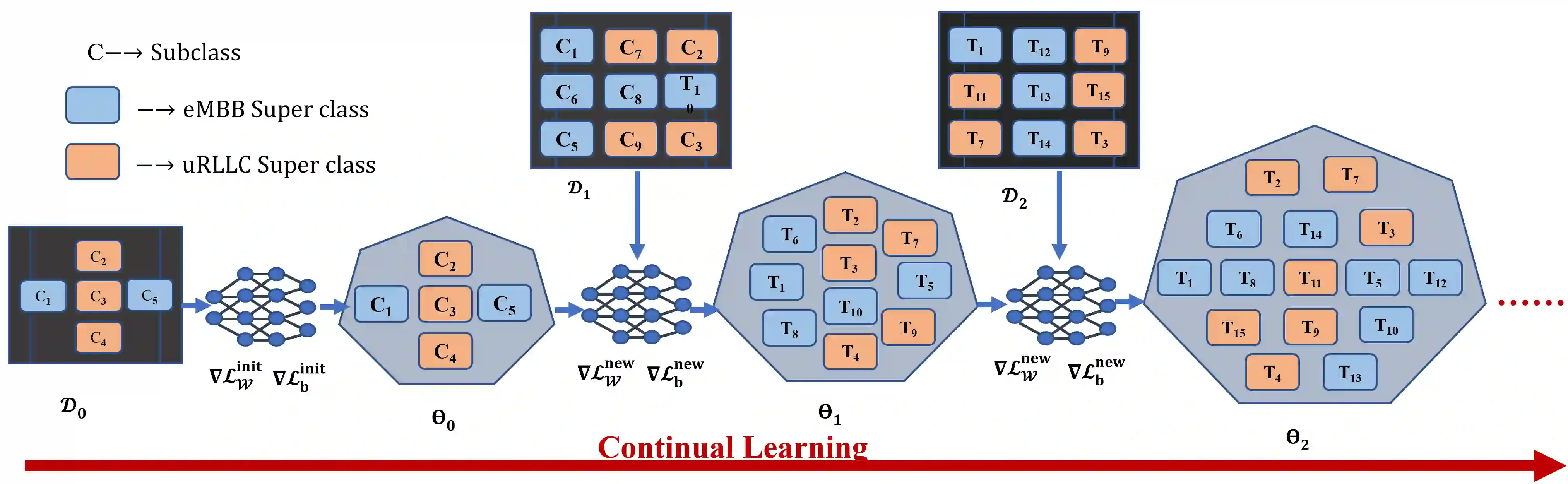
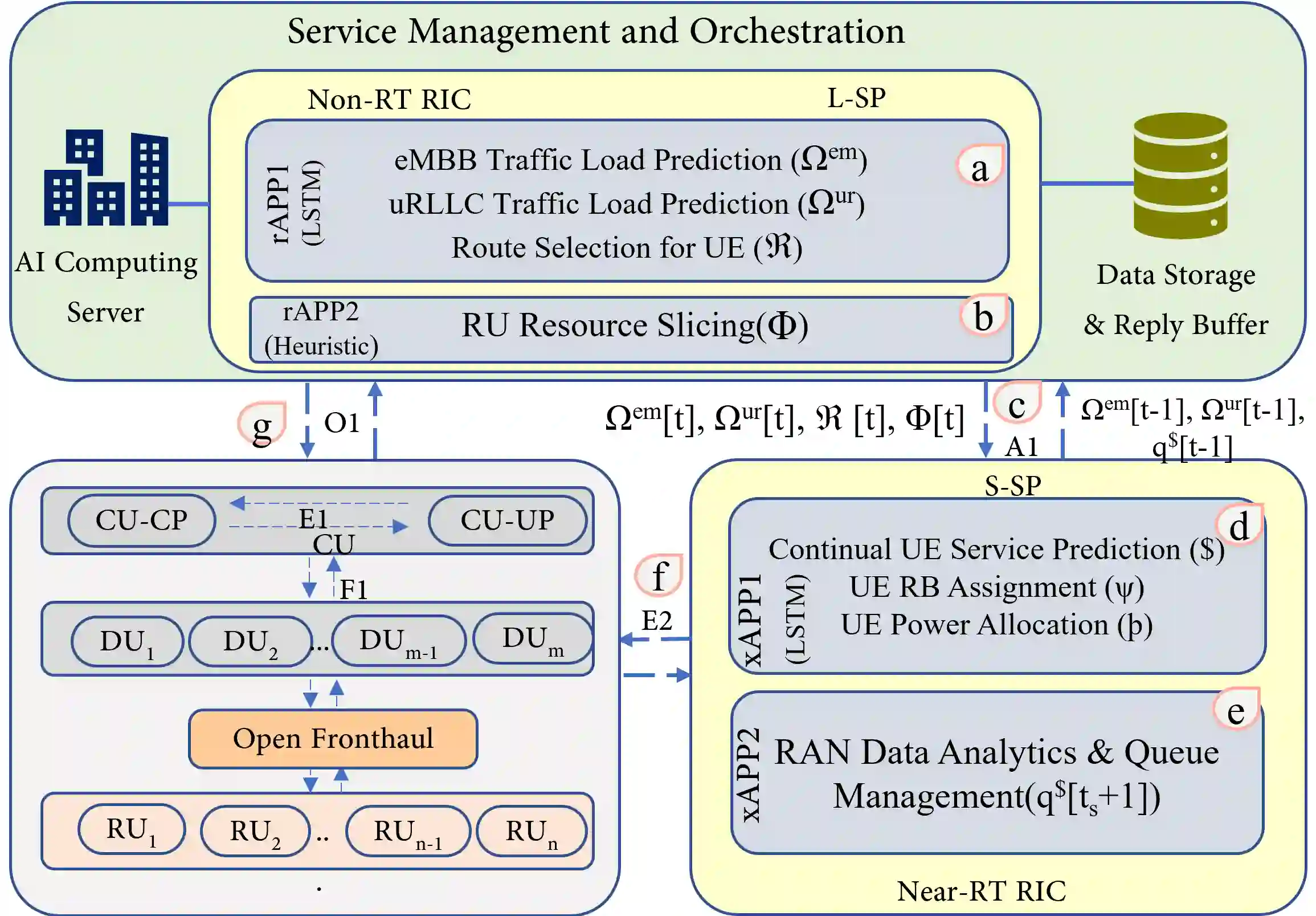
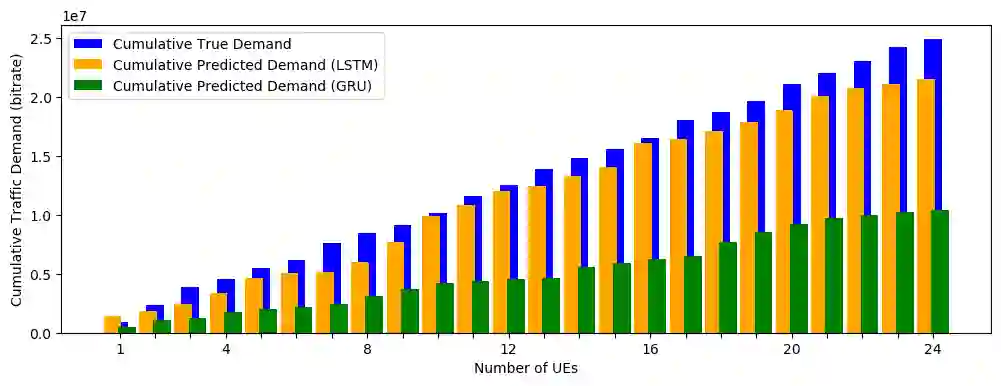
In this paper, an artificial intelligence (AI)-driven efficient RAN management framework is proposed. This framework introduces the concept of a introducing the multi-service-modal UE (MSMU) system, which allows a single UE to handle both eMBB and uRLLC services. The proposed framework integrates traffic demand prediction, route optimization, RAN slicing, service identification, and radio resource management under uncertainty. The challenge of dynamic environments in such a system is addressed by decomposing the optimization problem into long-term (L-SP) and short-term (S-SP) subproblems. Using a long short-term memory (LSTM) model, the proposed approach allows the prediction of eMBB and uRLLC traffic demands and optimal routes for RAN slicing in the L-SP. For the S-SP, another LSTM model is employed to handle real-time service type identification and resource management based on long-term predictions. To support continuous adaptation, continual learning is incorporated into the S-SP framework, allowing the model to learn new service types while retaining prior knowledge. Experimental results show that the proposed framework efficiently manages dual-mode UEs, achieving low mean square error for traffic demand (0.003), resource block prediction (0.003), and power prediction (0.002), with 99\% accuracy in service type and route selection and over 95\% average accuracy for continual service adaptation across seven tasks.
翻译:本文提出了一种人工智能驱动的高效无线接入网管理框架。该框架引入了多业务模态用户设备系统的概念,使单一用户设备能够同时处理增强型移动宽带和超可靠低时延通信业务。所提框架在不确定性条件下整合了流量需求预测、路由优化、无线接入网切片、业务识别与无线资源管理。通过将优化问题分解为长期子问题和短期子问题,解决了此类系统中动态环境带来的挑战。利用长短期记忆模型,所提方法能够预测增强型移动宽带与超可靠低时延通信的流量需求,并在长期子问题中为无线接入网切片确定最优路由。针对短期子问题,采用另一长短期记忆模型基于长期预测结果处理实时业务类型识别与资源管理。为支持持续自适应,短期子问题框架中引入了持续学习机制,使模型能够在学习新业务类型的同时保留先验知识。实验结果表明,所提框架能有效管理双模用户设备,在流量需求、资源块预测和功率预测方面分别获得0.003、0.003和0.002的低均方误差,业务类型与路由选择准确率达99%,在七项任务中持续业务自适应的平均准确率超过95%。




相关内容





 微信扫码咨询专知VIP会员