

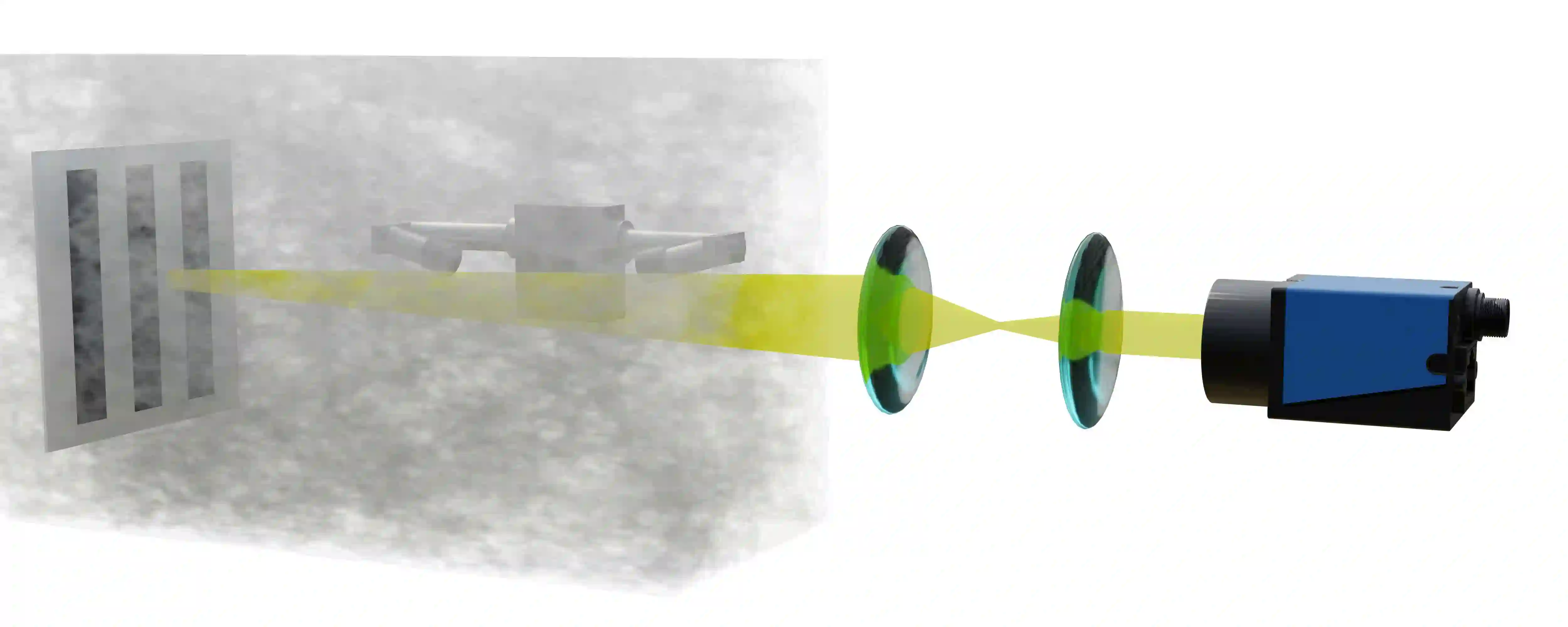
Recording and identifying faint objects through atmospheric scattering media by an optical system are fundamentally interesting and technologically important. In this work, we introduce a comprehensive model that incorporates contributions from target characteristics, atmospheric effects, imaging system, digital processing, and visual perception to assess the ultimate perceptible limit of geometrical imaging, specifically the angular resolution at the boundary of visible distance. The model allows to reevaluate the effectiveness of conventional imaging recording, processing, and perception and to analyze the limiting factors that constrain image recognition capabilities in atmospheric media. The simulations were compared with the experimental results measured in a fog chamber and outdoor settings. The results reveal general good agreement between analysis and experimental, pointing out the way to harnessing the physical limit for optical imaging in scattering media. An immediate application of the study is the extension of the image range by an amount of 1.2 times with noise reduction via multi-frame averaging, hence greatly enhancing the capability of optical imaging in the atmosphere.
翻译:通过大气散射介质进行光学系统记录和识别微弱目标,既具有基础科学意义,又具有重要技术价值。本文提出一个综合模型,该模型融合目标特性、大气效应、成像系统、数字处理及视觉感知的贡献,用于评估几何成像的终极可感知极限——具体而言为可视距离边界处的角分辨率。该模型可重新审视传统成像记录、处理及感知的有效性,并分析大气介质中制约图像识别能力的限制因素。我们将模拟结果与雾室及户外环境下的实验测量数据进行了对比。结果表明,分析与实验之间总体吻合良好,揭示了在散射介质中利用光学成像物理极限的途径。该研究的一个直接应用是:通过多帧平均降噪技术,将成像距离延伸1.2倍,从而显著提升大气环境中的光学成像能力。






相关内容





 微信扫码咨询专知VIP会员