

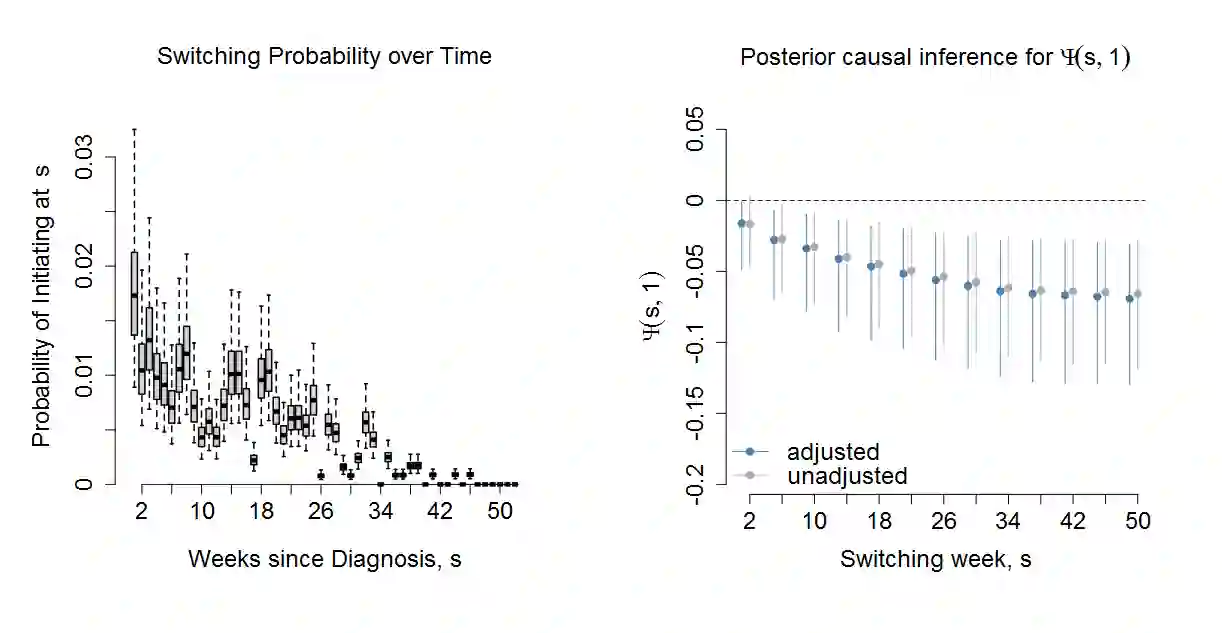
Observational studies of recurrent event rates are common in biomedical statistics. Broadly, the goal is to estimate differences in event rates under two treatments within a defined target population over a specified followup window. Estimation with observational claims data is challenging because while membership in the target population is defined in terms of eligibility criteria, treatment is rarely assigned exactly at the time of eligibility. Ad-hoc solutions to this timing misalignment, such as assigning treatment at eligibility based on subsequent assignment, incorrectly attribute prior event rates to treatment - resulting in immortal risk bias. Even if eligibility and treatment are aligned, a terminal event process (e.g. death) often stops the recurrent event process of interest. Both processes are also censored so that events are not observed over the entire followup window. Our approach addresses misalignment by casting it as a treatment switching problem: some patients are on treatment at eligibility while others are off treatment but may switch to treatment at a specified time - if they survive long enough. We define and identify an average causal effect of switching under specified causal assumptions. Estimation is done using a g-computation framework with a joint semiparametric Bayesian model for the death and recurrent event processes. Computing the estimand for various switching times allows us to assess the impact of treatment timing. We apply the method to contrast hospitalization rates under different opioid treatment strategies among patients with chronic back pain using Medicare claims data.
翻译:在生物医学统计中,对复发事件发生率的观察性研究十分常见。广义而言,其目标是在特定目标人群中,于给定的随访窗口内,估计两种治疗下事件发生率的差异。利用观察性理赔数据进行估计颇具挑战性,因为虽然目标人群的成员资格基于纳入标准定义,但治疗很少在符合资格的时间点精确分配。针对这种时间错位的临时解决方案(例如根据后续分配在符合资格时指定治疗)会错误地将先前的事件发生率归因于治疗,从而导致永生风险偏倚。即使资格和治疗的时机对齐,一个终点事件过程(例如死亡)通常也会终止我们所关注的复发事件过程。这两种过程均存在删失,因此无法在整个随访窗口内观察到事件。我们的方法通过将错位问题视为一个治疗切换问题来解决:某些患者在符合资格时正在接受治疗,而另一些患者则未接受治疗,但如果他们存活足够长时间,则可能在指定时间切换到治疗。我们在特定因果假设下定义并识别了切换的平均因果效应。估计采用g-计算公式框架,结合了死亡和复发事件过程的联合半参数贝叶斯模型。针对不同切换时间计算估计量,使我们能够评估治疗时机的影响。我们利用该方法,基于医疗保险理赔数据,对比了慢性背痛患者在不同阿片类药物治疗策略下的住院率。




相关内容

 微信扫码咨询专知VIP会员