

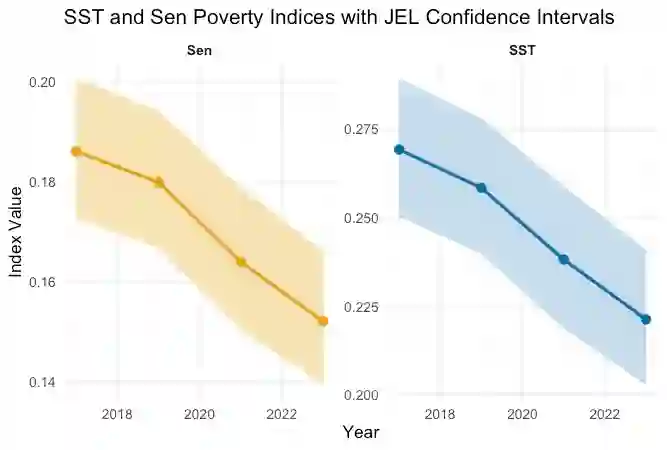
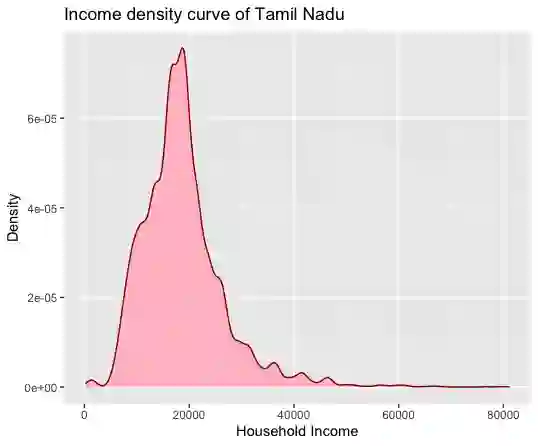
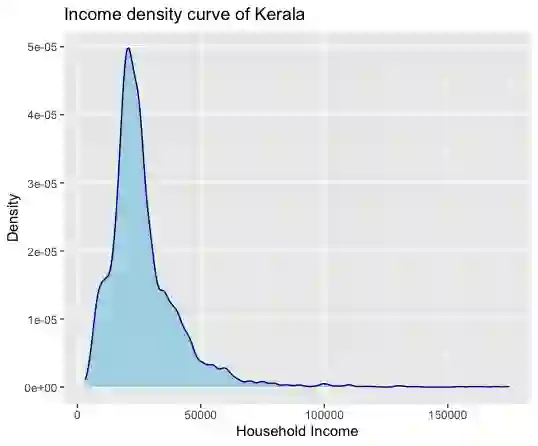
The Sen index and Sen-Shorrocks-Thon (SST) index are widely used measures of poverty indices. Developing reliable inference for these measures enables us to compare these measures in different populations of interest in an effective way. It is important to construct confidence intervals for the Sen index and SST index, which provide better coverage probability and shorter interval length. Motivated by this, we discuss empirical likelihood (EL) and jackknife empirical likelihood (JEL) based inference for the Sen index. To derive a JEL-based confidence interval for the Sen and SST indices, we propose a new estimator for the Sen index using the theory of U-statistics and examine its properties. The large sample properties of the EL and JEL ratio statistics are studied. We also discuss EL and JEL-based inference for the Sen-Shorrocks-Thon (SST) index. The finite sample performance of the EL and JEL-based confidence intervals of both Sen and SST indices is evaluated through a Monte Carlo simulation study. Finally, we illustrate our methods using individual-level data from the Panel Study of Income Dynamics (PSID) survey from the US as well as Indian household level income data for different states sourced from the Consumer Pyramids Household Survey (CPHS).
翻译:Sen指数与Sen-Shorrocks-Thon(SST)指数是广泛应用的贫困度量指标。为这些度量建立可靠的推断方法,使我们能够有效比较不同目标群体间的这些指标。构建具有更高覆盖概率与更短区间长度的Sen指数与SST指数置信区间具有重要意义。基于此动机,本文探讨了基于经验似然(EL)与刀切经验似然(JEL)的Sen指数推断方法。为推导基于JEL的Sen指数与SST指数置信区间,我们利用U统计量理论提出了一种新的Sen指数估计量,并考察了其性质。研究了EL与JEL比统计量的大样本性质。同时讨论了基于EL与JEL的Sen-Shorrocks-Thon(SST)指数推断方法。通过蒙特卡洛模拟研究评估了Sen指数与SST指数基于EL与JEL的置信区间在有限样本下的表现。最后,我们使用美国收入动态追踪研究(PSID)调查的个体层面数据,以及来自印度家庭消费金字塔调查(CPHS)的各邦家庭收入数据,对所述方法进行了实证演示。




相关内容



 微信扫码咨询专知VIP会员