

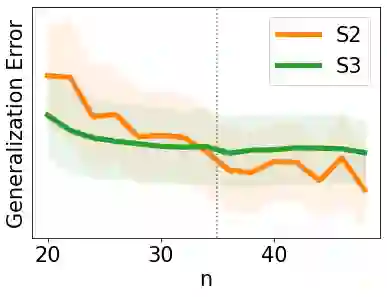
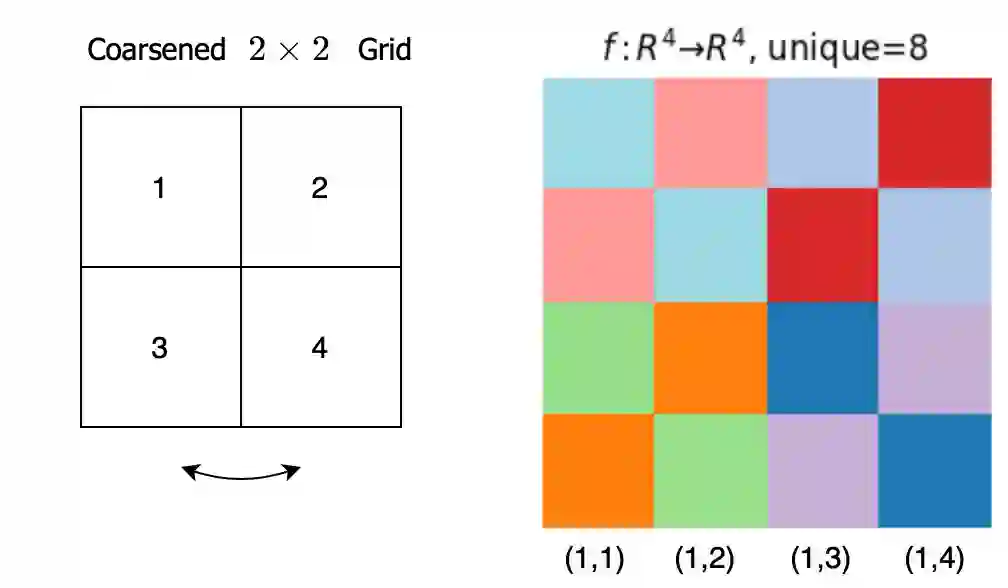
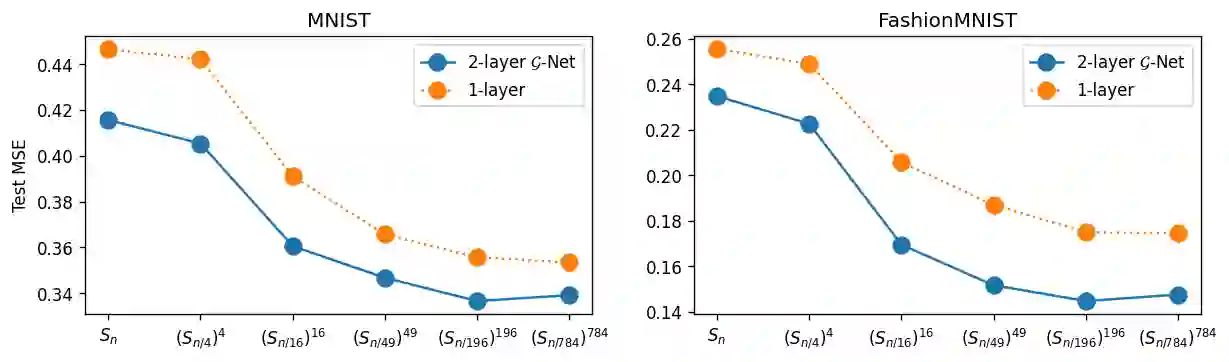
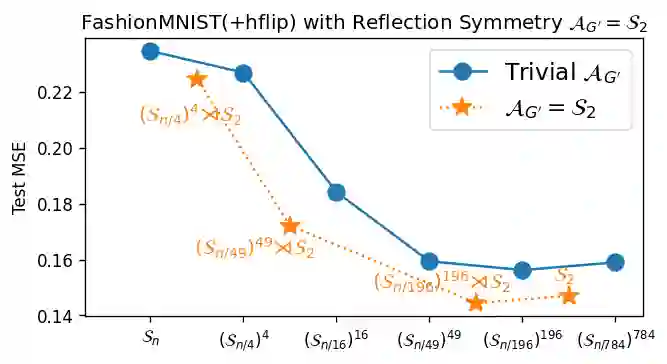
Graph neural networks (GNNs) are commonly described as being permutation equivariant with respect to node relabeling in the graph. This symmetry of GNNs is often compared to the translation equivariance of Euclidean convolution neural networks (CNNs). However, these two symmetries are fundamentally different: The translation equivariance of CNNs corresponds to symmetries of the fixed domain acting on the image signals (sometimes known as active symmetries), whereas in GNNs any permutation acts on both the graph signals and the graph domain (sometimes described as passive symmetries). In this work, we focus on the active symmetries of GNNs, by considering a learning setting where signals are supported on a fixed graph. In this case, the natural symmetries of GNNs are the automorphisms of the graph. Since real-world graphs tend to be asymmetric, we relax the notion of symmetries by formalizing approximate symmetries via graph coarsening. We present a bias-variance formula that quantifies the tradeoff between the loss in expressivity and the gain in the regularity of the learned estimator, depending on the chosen symmetry group. To illustrate our approach, we conduct extensive experiments on image inpainting, traffic flow prediction, and human pose estimation with different choices of symmetries. We show theoretically and empirically that the best generalization performance can be achieved by choosing a suitably larger group than the graph automorphism, but smaller than the permutation group.
翻译:图神经网络(GNN)通常被描述为在图中节点重标号下具有置换等变性。这种GNN对称性常被比作欧几里得卷积神经网络(CNN)的平移等变性。然而这两种对称性存在根本区别:CNN的平移等变性对应于固定域作用于图像信号的对称性(有时称为主动对称性),而GNN中任何置换同时作用于图信号和图域(有时称为被动对称性)。本研究聚焦于GNN的主动对称性,考虑信号支撑于固定图的学习场景。此时GNN的自然对称性为图的自同构。鉴于真实图往往不对称,我们通过图粗化形式化近似对称性来放宽对称性概念。我们提出偏差-方差公式,量化表达性损失与学习估计器正则性增益之间的权衡关系,该权衡取决于所选对称群。为阐明该方法,我们在图像修复、交通流预测和人体姿态估计等任务中,针对不同对称性选择进行了大量实验。理论与实证表明,选择适当大于图自同构但小于置换群的对称群,可获得最优泛化性能。




相关内容



 微信扫码咨询专知VIP会员