

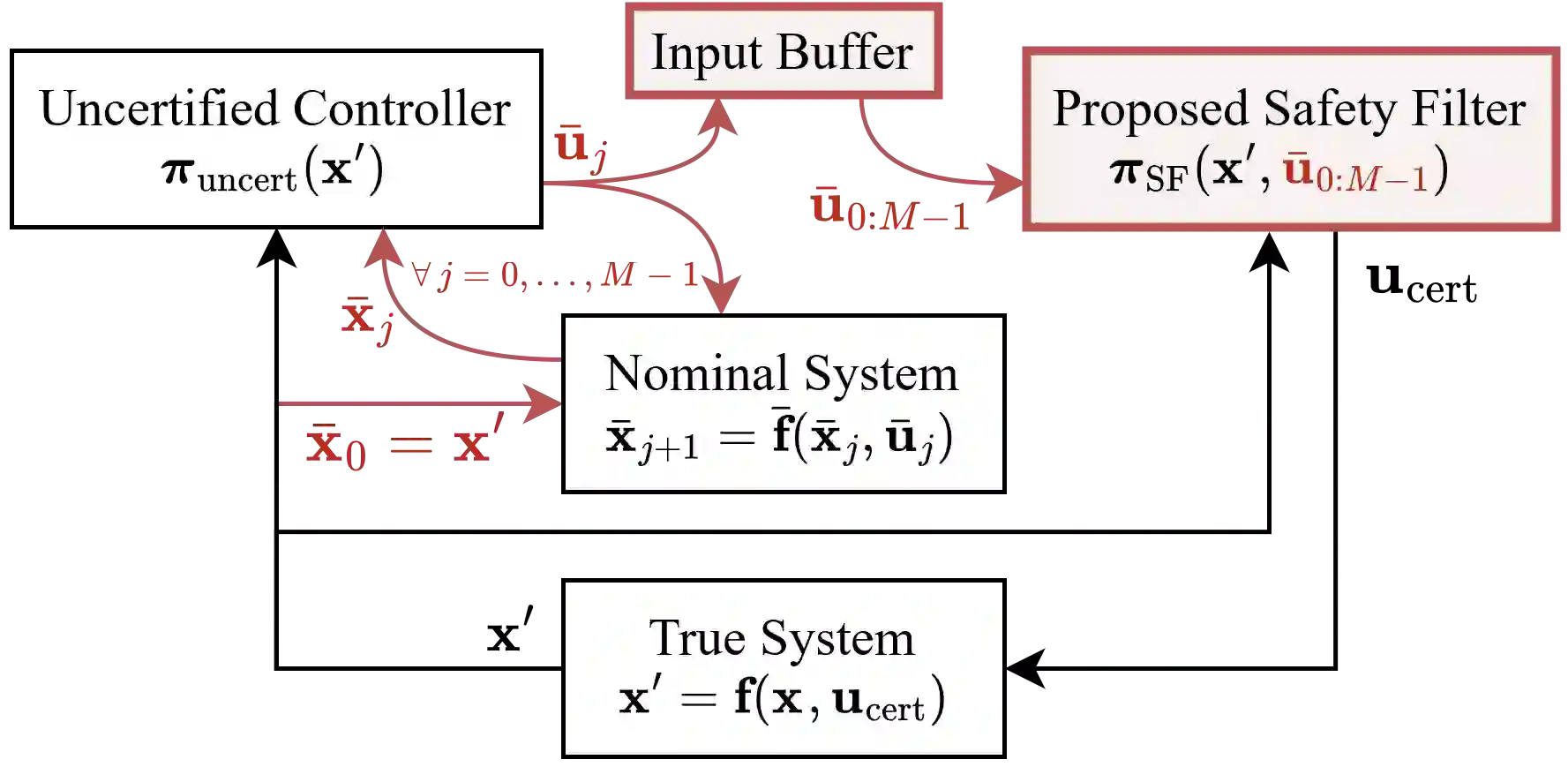
Learning-based controllers have demonstrated superior performance compared to classical controllers in various tasks. However, providing safety guarantees is not trivial. Safety, the satisfaction of state and input constraints, can be guaranteed by augmenting the learned control policy with a safety filter. Model predictive safety filters (MPSFs) are a common safety filtering approach based on model predictive control (MPC). MPSFs seek to guarantee safety while minimizing the difference between the proposed and applied inputs in the immediate next time step. This limited foresight can lead to jerky motions and undesired oscillations close to constraint boundaries, known as chattering. In this paper, we reduce chattering by considering input corrections over a longer horizon. Under the assumption of bounded model uncertainties, we prove recursive feasibility using techniques from robust MPC. We verified the proposed approach in both extensive simulation and quadrotor experiments. In experiments with a Crazyflie 2.0 drone, we show that, in addition to preserving the desired safety guarantees, the proposed MPSF reduces chattering by more than a factor of 4 compared to previous MPSF formulations.
翻译:基于学习的控制器在各类任务中展现出优于经典控制器的性能,但提供安全保障并非易事。通过为学习策略增设安全滤波器,可确保状态与输入约束得到满足。模型预测安全滤波器(Model Predictive Safety Filters, MPSFs)是一种基于模型预测控制(MPC)的常见安全滤波方法。MPSFs致力于在保证安全性的同时,最小化当前时刻提议输入与实际施加输入之间的偏差。这种短视性会导致约束边界附近的剧烈运动与不期望的振荡,即所谓的"抖动"现象。本文通过延长输入修正的预测时域来抑制抖动。在模型不确定性有界的假设下,我们基于鲁棒MPC技术证明了递归可行性。通过大规模仿真与四旋翼飞行器实验验证了所提方法。在Crazyflie 2.0无人机实验中表明:该MPSF在保持预期安全保障的同时,相比传统MPSF方案可将抖动幅度降低超过4倍。





相关内容





 微信扫码咨询专知VIP会员