

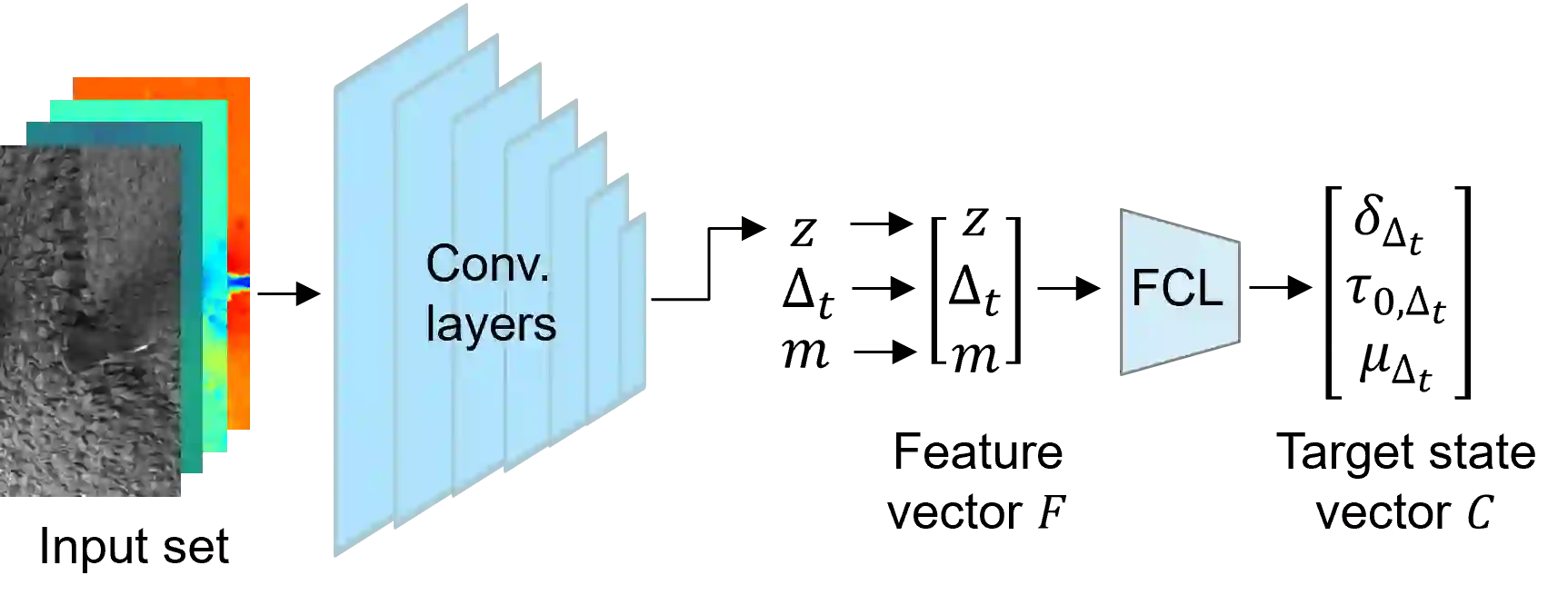
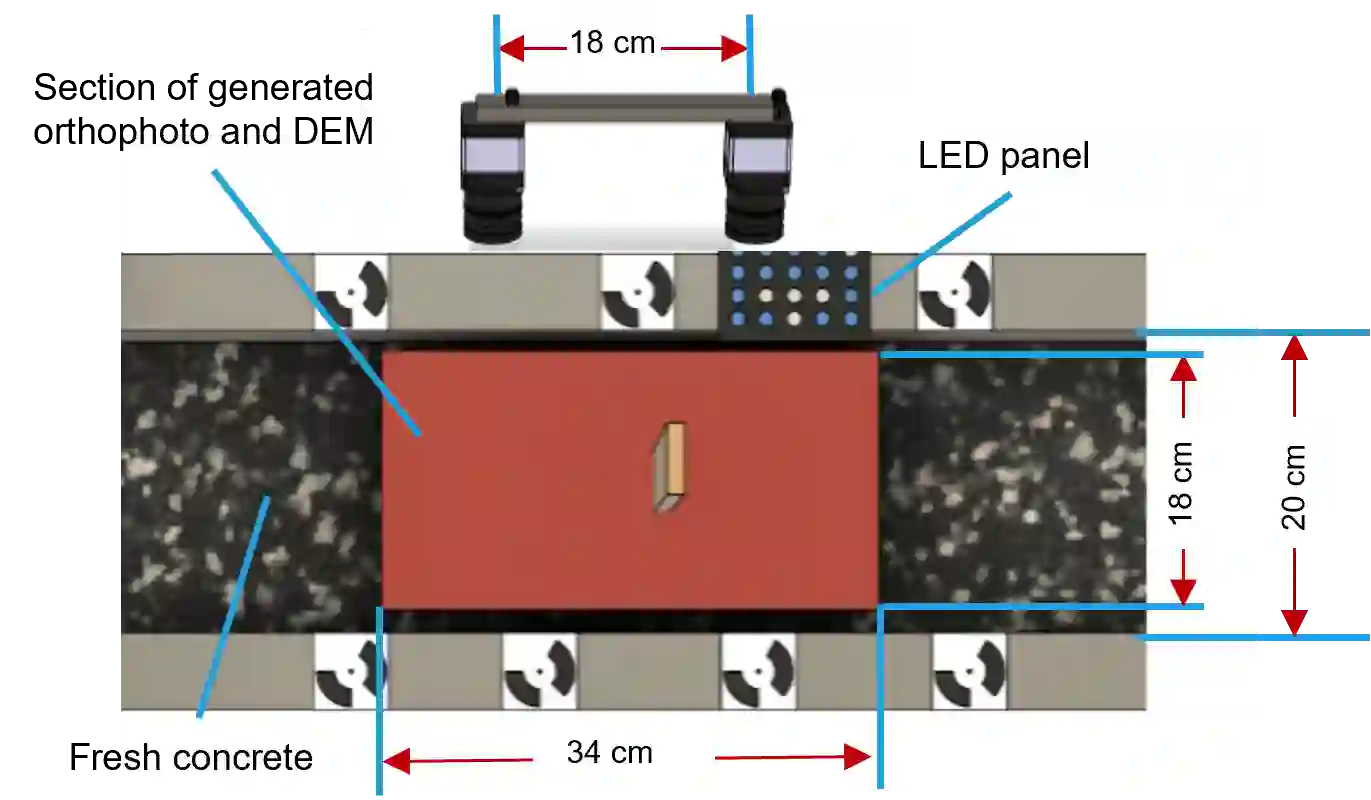
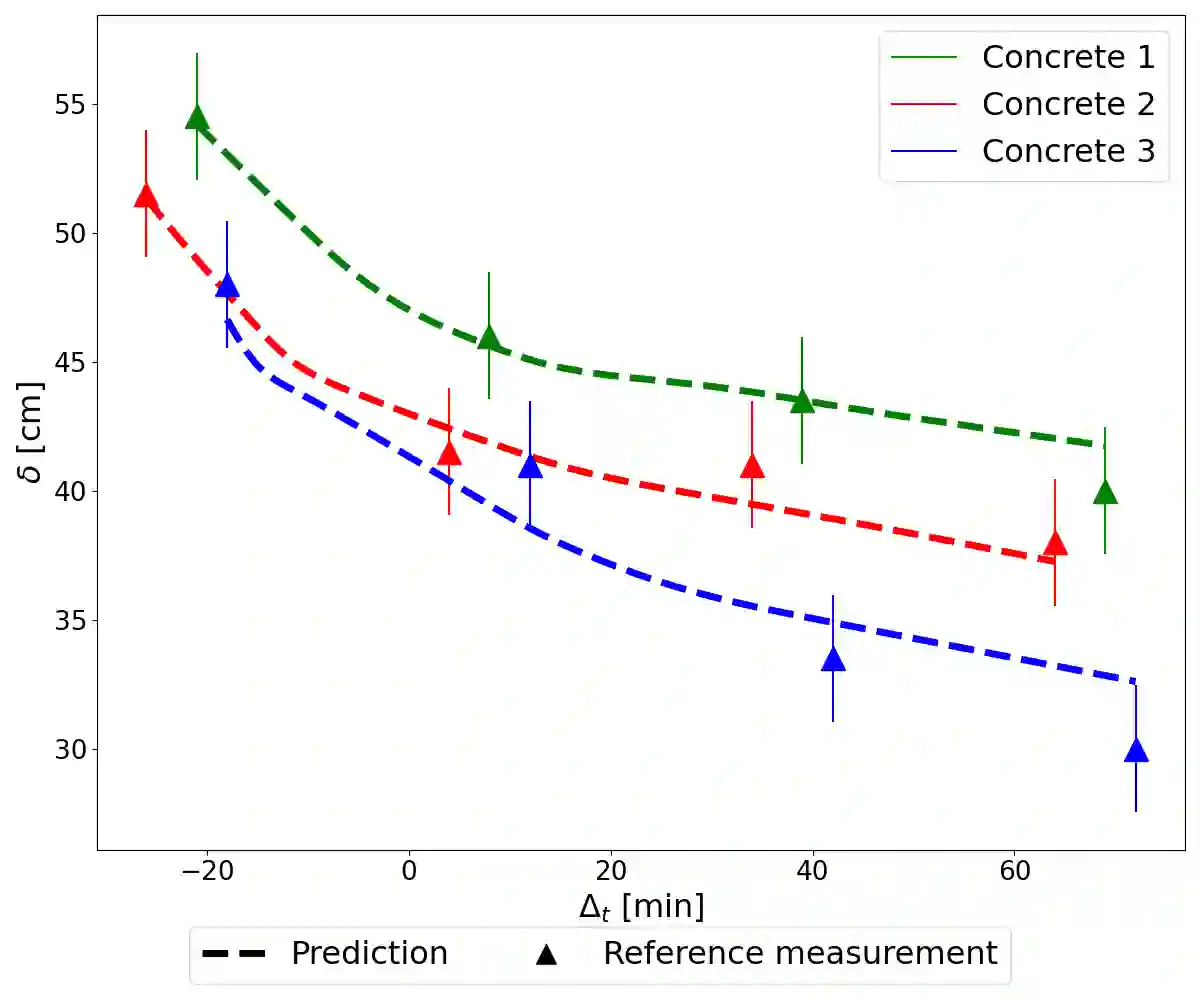
Increasing the degree of digitisation and automation in the concrete production process can play a crucial role in reducing the CO$_2$ emissions that are associated with the production of concrete. In this paper, a method is presented that makes it possible to predict the properties of fresh concrete during the mixing process based on stereoscopic image sequences of the concretes flow behaviour. A Convolutional Neural Network (CNN) is used for the prediction, which receives the images supported by information on the mix design as input. In addition, the network receives temporal information in the form of the time difference between the time at which the images are taken and the time at which the reference values of the concretes are carried out. With this temporal information, the network implicitly learns the time-dependent behaviour of the concretes properties. The network predicts the slump flow diameter, the yield stress and the plastic viscosity. The time-dependent prediction potentially opens up the pathway to determine the temporal development of the fresh concrete properties already during mixing. This provides a huge advantage for the concrete industry. As a result, countermeasures can be taken in a timely manner. It is shown that an approach based on depth and optical flow images, supported by information of the mix design, achieves the best results.
翻译:提高混凝土生产过程中的数字化和自动化程度,对于减少与混凝土生产相关的CO₂排放具有关键作用。本文提出了一种方法,能够基于混凝土流动行为的立体图像序列,在搅拌过程中预测新拌混凝土的性能。该预测采用卷积神经网络(CNN),其输入为结合配合比设计信息的图像数据。此外,网络还接收时间信息——即图像采集时间与混凝土参考值测定时间之间的时间差。凭借这一时间信息,网络能够隐式学习混凝土性能的时间依赖特性。该网络可预测坍落扩展度、屈服应力和塑性粘度。时间依赖预测有望在搅拌过程中确定新拌混凝土性能的随时间演变,这为混凝土行业带来了巨大优势,从而可以及时采取应对措施。研究表明,基于深度图像和光流图像、并辅以配合比设计信息的方法取得了最佳结果。




相关内容





 微信扫码咨询专知VIP会员