

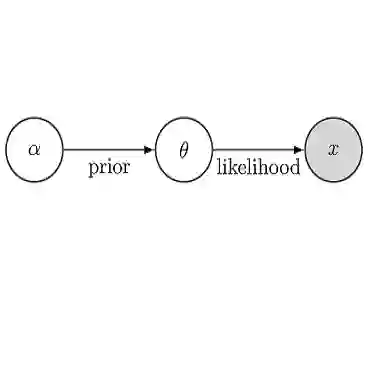
The rapid advancement of data science and artificial intelligence has influenced physics in numerous ways, including the application of Bayesian inference. Our group has proposed Bayesian measurement, a framework that applies Bayesian inference to measurement science and is applicable across various natural sciences. This framework enables the determination of posterior probability distributions for system parameters, model selection, and the integration of multiple measurement datasets. However, a theoretical framework to address fluctuations in these results due to finite measurement data (N) is still needed. In this paper, we suggest a mesoscopic theoretical framework for the components of Bayesian measurement-parameter estimation, model selection, and Bayesian integration-within the mesoscopic region where (N) is finite. We develop a solvable theory for linear regression with Gaussian noise, which is practical for real-world measurements and as an approximation for nonlinear models with large (N). By utilizing mesoscopic Gaussian and chi-squared distributions, we aim to analytically evaluate the three components of Bayesian measurement. Our results offer a novel approach to understanding fluctuations in Bayesian measurement outcomes.
翻译:数据科学与人工智能的快速发展以多种方式影响了物理学,其中包括贝叶斯推断的应用。我们团队提出了贝叶斯测量这一框架,该框架将贝叶斯推断应用于测量科学,并适用于各类自然科学。该框架能够确定系统参数的后验概率分布、实现模型选择以及整合多个测量数据集。然而,目前仍需一个理论框架来处理因有限测量数据(N)导致的这些结果的涨落。本文提出了一种针对贝叶斯测量组成部分(参数估计、模型选择与贝叶斯集成)的介观理论框架,该框架适用于N为有限的介观区域。我们针对高斯噪声下的线性回归发展了一套可解理论,该理论既适用于实际测量,也可作为大N情况下非线性模型的近似。通过利用介观高斯分布与卡方分布,我们旨在解析评估贝叶斯测量的三个组成部分。我们的结果为理解贝叶斯测量结果的涨落提供了一种新途径。




相关内容



 微信扫码咨询专知VIP会员