

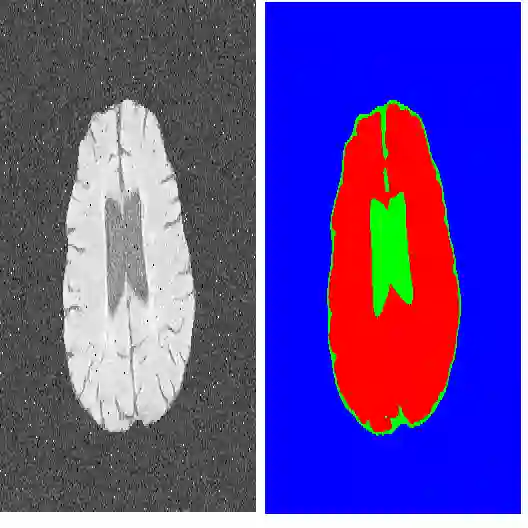
Voxel-based multiple testing is widely used in neuroimaging data analysis. Traditional false discovery rate (FDR) control methods often ignore the spatial dependence among the voxel-based tests and thus suffer from substantial loss of testing power. While recent spatial FDR control methods have emerged, their validity and optimality remain questionable when handling the complex spatial dependencies of the brain. Concurrently, deep learning methods have revolutionized image segmentation, a task closely related to voxel-based multiple testing. In this paper, we propose DeepFDR, a novel spatial FDR control method that leverages unsupervised deep learning-based image segmentation to address the voxel-based multiple testing problem. Numerical studies, including comprehensive simulations and Alzheimer's disease FDG-PET image analysis, demonstrate DeepFDR's superiority over existing methods. DeepFDR not only excels in FDR control and effectively diminishes the false nondiscovery rate, but also boasts exceptional computational efficiency highly suited for tackling large-scale neuroimaging data.
翻译:基于体素的多重检验广泛应用于神经影像数据分析。传统错误发现率(FDR)控制方法常忽略体素检验间的空间依赖性,导致检验功效显著降低。尽管近年来涌现出多种空间FDR控制方法,但在处理大脑复杂空间依赖性时,其有效性和最优性仍存疑问。与此同时,深度学习在图像分割领域引发革命,而图像分割任务与基于体素的多重检验密切相关。本文提出DeepFDR——一种利用无监督深度学习图像分割技术解决体素多重检验问题的新型空间FDR控制方法。数值实验(包括综合模拟实验与阿尔茨海默病FDG-PET图像分析)表明,DeepFDR在控制FDR、有效降低错误非发现率方面均显著优于现有方法,且具备卓越的计算效率,特别适用于大规模神经影像数据的处理。




相关内容




 微信扫码咨询专知VIP会员