

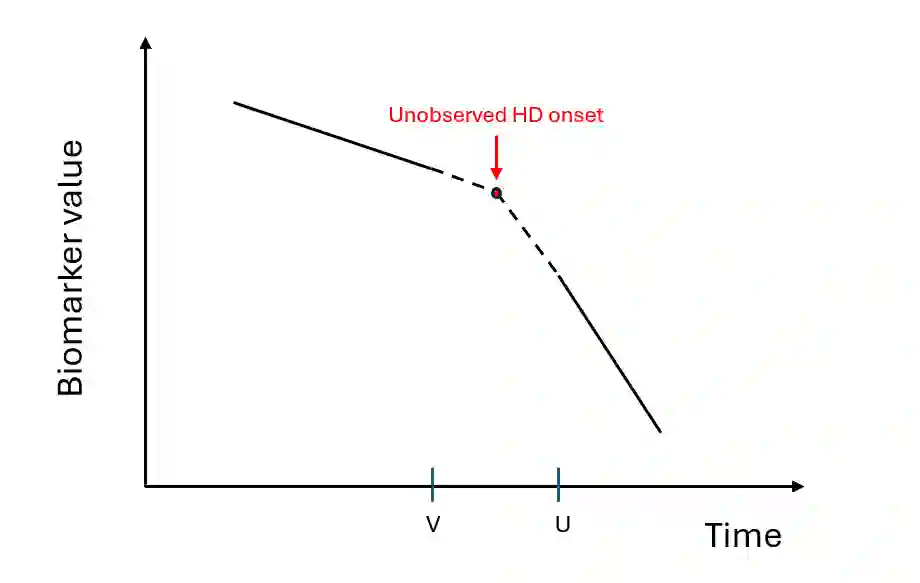
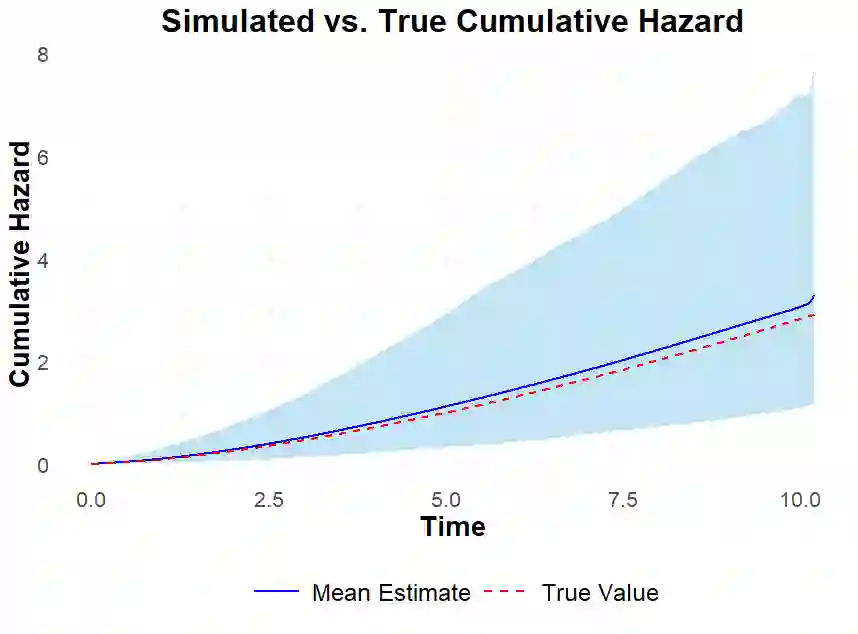
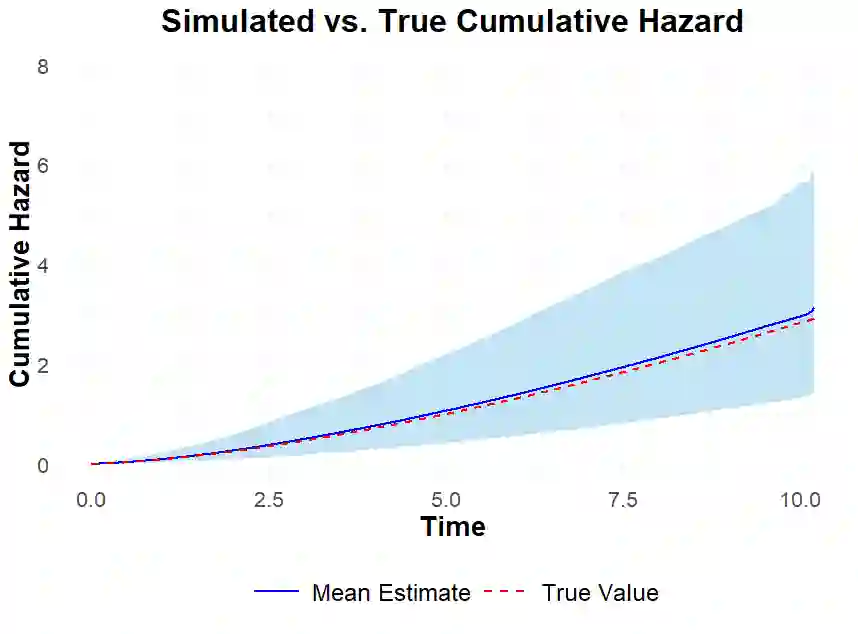
Huntington's disease (HD) is an autosomal dominant neurodegenerative disorder characterized by motor dysfunction, psychiatric disturbances, and cognitive decline. The onset of HD is marked by severe motor impairment, which may be predicted by prior cognitive decline and, in turn, exacerbate cognitive deficits. Clinical data, however, are often collected at discrete time points, so the timing of disease onset is subject to interval censoring. To address the challenges posed by such data, we develop a joint model for multivariate longitudinal biomarkers with a change point anchored at an interval-censored event time. The model simultaneously assesses the effects of longitudinal biomarkers on the event time and the changes in biomarker trajectories following the event. We conduct a comprehensive simulation study to demonstrate the finite-sample performance of the proposed method for causal inference. Finally, we apply the method to PREDICT-HD, a multisite observational cohort study of prodromal HD individuals, to ascertain how cognitive impairment and motor dysfunction interact during disease progression.
翻译:亨廷顿病(HD)是一种常染色体显性遗传的神经退行性疾病,其特征包括运动功能障碍、精神障碍和认知衰退。HD的发病以严重的运动损伤为标志,而发病前认知衰退可能预测其发生,发病后又会加剧认知缺陷。然而,临床数据通常在离散时间点收集,因此疾病发病时间存在区间删失。为应对此类数据带来的挑战,我们建立了一个针对多元纵向生物标志物的联合模型,该模型包含一个锚定于区间删失事件时间的变点。该模型同时评估了纵向生物标志物对事件时间的影响,以及事件发生后生物标志物轨迹的变化。我们进行了全面的模拟研究,以验证所提方法在因果推断中的有限样本性能。最后,我们将该方法应用于PREDICT-HD——一项针对前驱期HD个体的多中心观察性队列研究,以确定认知障碍与运动功能障碍在疾病进展过程中如何相互作用。




相关内容



 微信扫码咨询专知VIP会员