

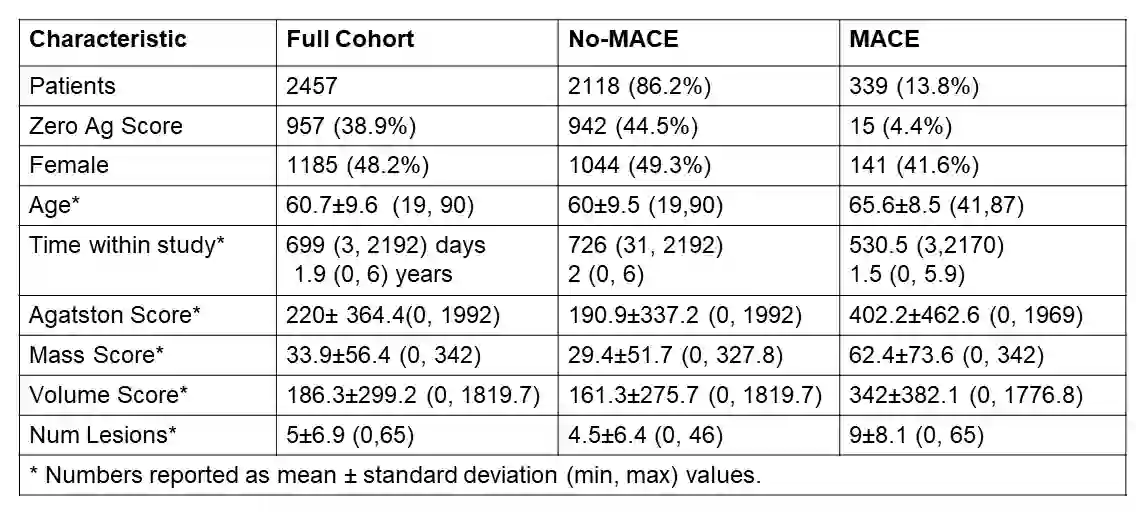
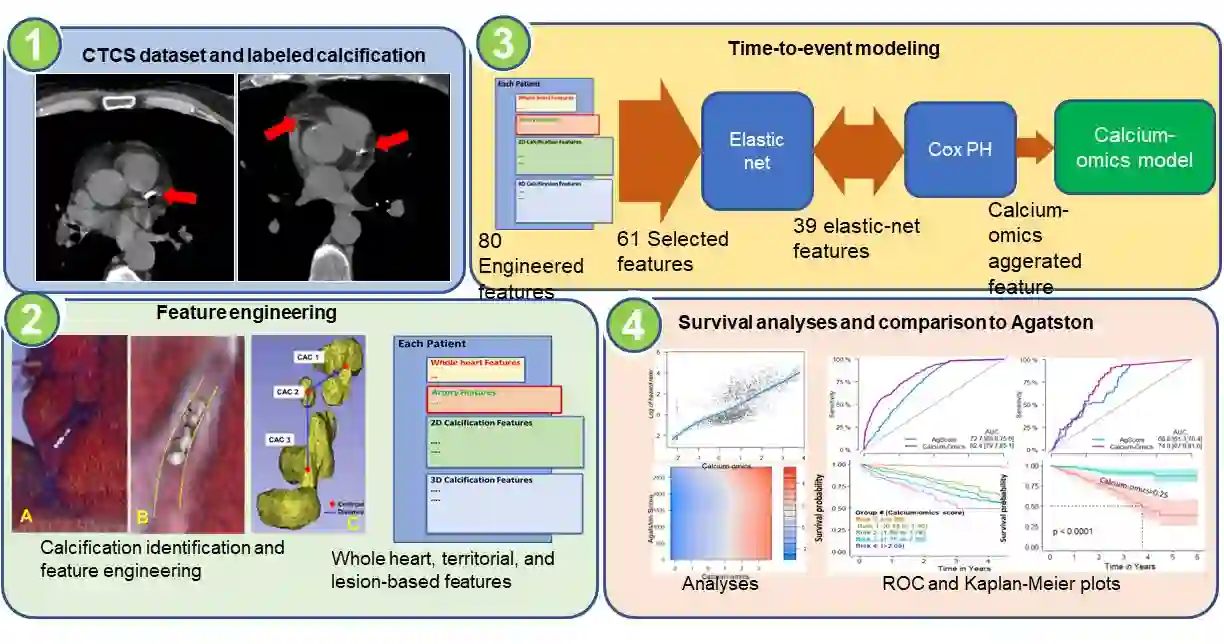
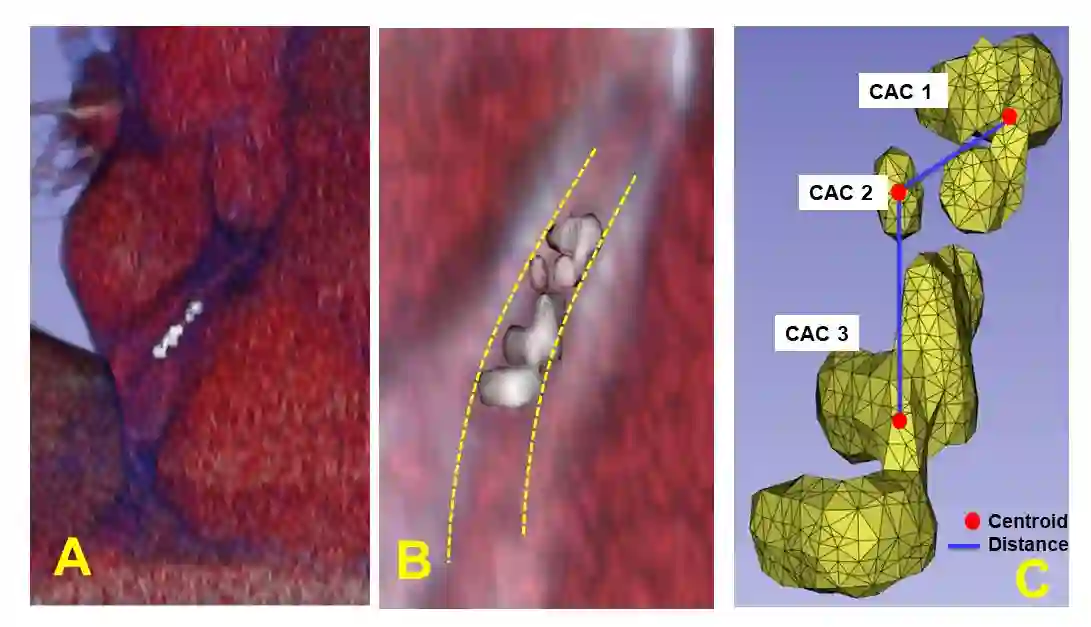
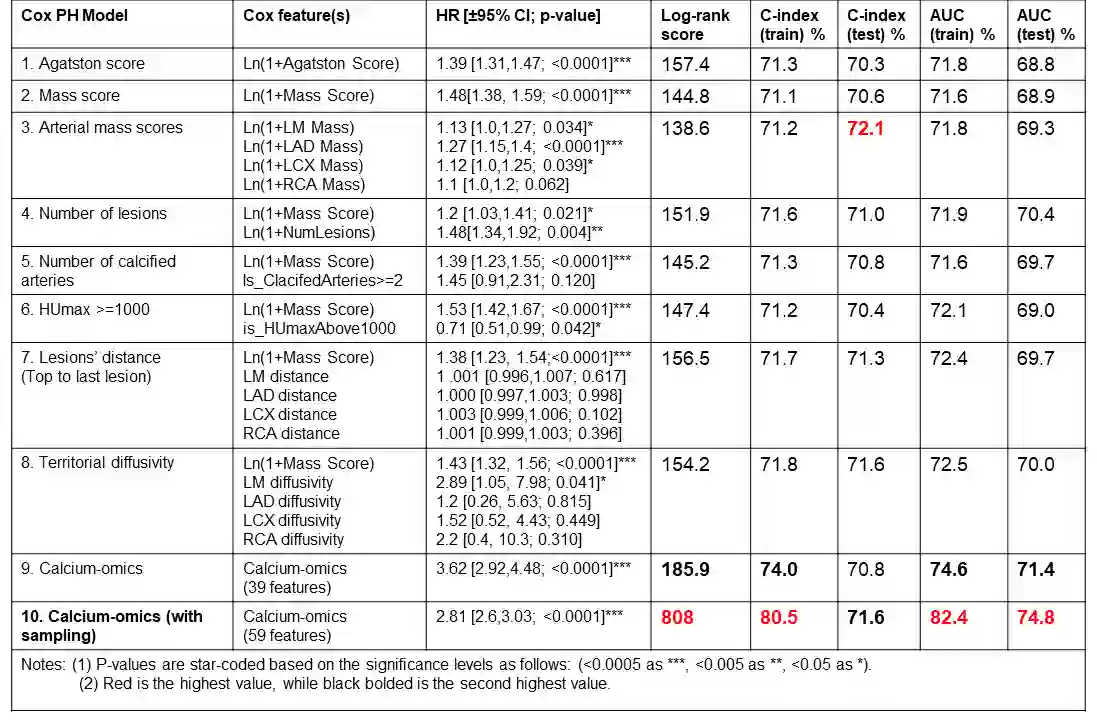
Background. Coronary artery calcium (CAC) is a powerful predictor of major adverse cardiovascular events (MACE). Traditional Agatston score simply sums the calcium, albeit in a non-linear way, leaving room for improved calcification assessments that will more fully capture the extent of disease. Objective. To determine if AI methods using detailed calcification features (i.e., calcium-omics) can improve MACE prediction. Methods. We investigated additional features of calcification including assessment of mass, volume, density, spatial distribution, territory, etc. We used a Cox model with elastic-net regularization on 2457 CT calcium score (CTCS) enriched for MACE events obtained from a large no-cost CLARIFY program (ClinicalTri-als.gov Identifier: NCT04075162). We employed sampling techniques to enhance model training. We also investigated Cox models with selected features to identify explainable high-risk characteristics. Results. Our proposed calcium-omics model with modified synthetic down sampling and up sampling gave C-index (80.5%/71.6%) and two-year AUC (82.4%/74.8%) for (80:20, training/testing), respectively (sampling was applied to the training set only). Results compared favorably to Agatston which gave C-index (71.3%/70.3%) and AUC (71.8%/68.8%), respectively. Among calcium-omics features, numbers of calcifications, LAD mass, and diffusivity (a measure of spatial distribution) were important determinants of increased risk, with dense calcification (>1000HU) associated with lower risk. The calcium-omics model reclassified 63% of MACE patients to the high risk group in a held-out test. The categorical net-reclassification index was NRI=0.153. Conclusions. AI analysis of coronary calcification can lead to improved results as compared to Agatston scoring. Our findings suggest the utility of calcium-omics in improved prediction of risk.
翻译:背景:冠状动脉钙化(CAC)是主要不良心血管事件(MACE)的强效预测因子。传统Agatston评分以非线性方式简单累加钙化量,未能充分反映疾病程度,在钙化评估方面仍有改进空间。目的:探究利用人工智能方法分析精细钙化特征(即钙化组学)能否提升MACE预测效能。方法:本研究纳入钙化的质量、体积、密度、空间分布、区域等扩展特征。基于包含MACE事件富集的2457例CT钙化评分(CTCS)数据(源自大型免费CLARIFY项目,临床试验注册号:NCT04075162),采用弹性网络正则化的Cox模型进行建模。通过采样技术优化模型训练,同时利用特征筛选后的Cox模型识别可解释的高风险特征。结果:本研究所提出的钙化组学模型经修正合成降采样与上采样处理后,在训练集/测试集(80:20比例,仅对训练集进行采样)上获得C指数(80.5%/71.6%)和两年AUC值(82.4%/74.8%)。对比Agatston评分的C指数(71.3%/70.3%)与AUC值(71.8%/68.8%),本模型表现更优。钙化组学特征中,钙化灶数量、左前降支质量及扩散度(空间分布指标)是风险升高的关键决定因素,而致密钙化(CT值>1000HU)则与较低风险相关。在保留测试集中,钙化组学模型将63%的MACE患者重新分类至高风险组,分类净重分类指数(NRI)为0.153。结论:相较于Agatston评分,基于人工智能的冠状动脉钙化分析可获得更优结果。本研究证实钙化组学在提升风险预测效能方面具有重要价值。




相关内容



 微信扫码咨询专知VIP会员