

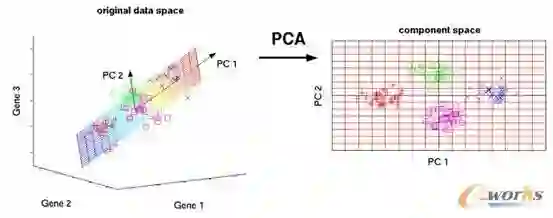
The Council on Environmental Quality's Climate and Economic Justice Screening Tool defines "disadvantaged communities" (DAC) in the USA, highlighting census tracts where benefits of climate and energy investments are not accruing. We use a principal component generalized linear model, which addresses the intertwined nature of economic factors, income and employment and model their relationship to DAC status. Our study 1) identifies the most significant income groups and employment industries that impact DAC status, 2) provides the probability of DAC status across census tracts and compares the predictive accuracy with widely used machine learning approaches, 3) obtains historical predictions of the probability of DAC status, 4) obtains spatial downscaling of DAC status across block groups. Our study provides valuable insights for policymakers and stakeholders to develop strategies that promote sustainable development and address inequities in climate and energy investments in the USA.
翻译:美国环境质量委员会的气候与经济公正筛查工具将“弱势社区”(DAC)定义为那些气候与能源投资未能惠及的普查区。我们采用主成分广义线性模型,该方法能够处理经济因素(收入与就业)之间的相互关联性,并模拟其与DAC状态的关系。本研究旨在:1)识别影响DAC状态的最显著收入群体与就业行业;2)预测各普查区的DAC状态概率,并与广泛使用的机器学习方法进行预测精度对比;3)获取DAC状态概率的历史预测值;4)实现对街区组层面的DAC状态空间降尺度。本研究为政策制定者及利益相关者制定促进可持续发展、解决美国气候与能源投资不公问题的策略提供了重要参考。




相关内容


 微信扫码咨询专知VIP会员