

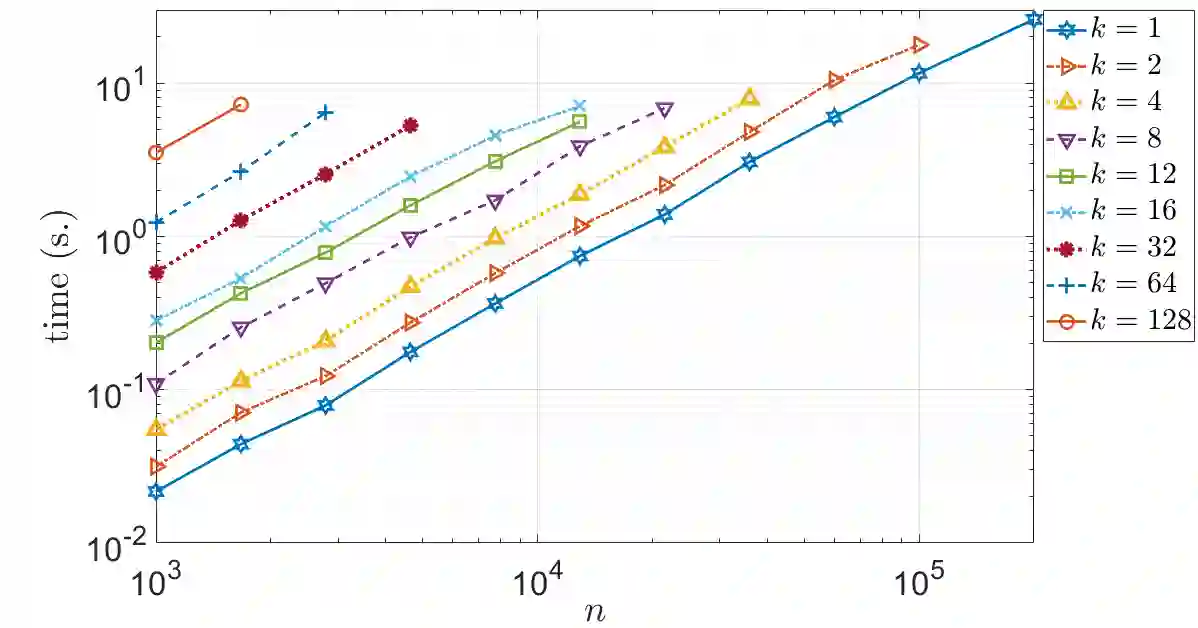
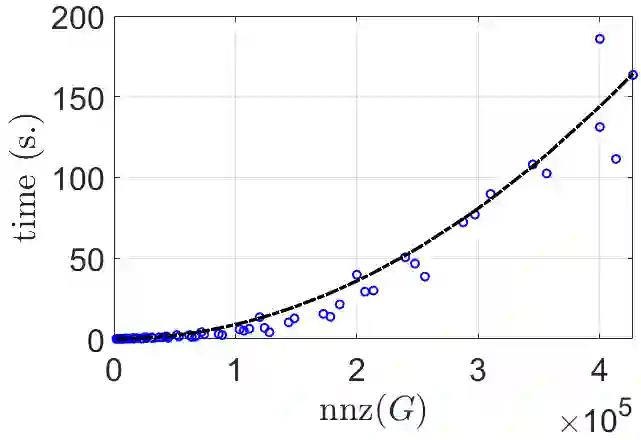
The target stationary distribution problem (TSDP) is the following: given an irreducible stochastic matrix $G$ and a target stationary distribution $\hat \mu$, construct a minimum norm perturbation, $\Delta$, such that $\hat G = G+\Delta$ is also stochastic and has the prescribed target stationary distribution, $\hat \mu$. In this paper, we revisit the TSDP under a constraint on the support of $\Delta$, that is, on the set of non-zero entries of $\Delta$. This is particularly meaningful in practice since one cannot typically modify all entries of $G$. We first show how to construct a feasible solution $\hat G$ that has essentially the same support as the matrix $G$. Then we show how to compute globally optimal and sparse solutions using the component-wise $\ell_1$ norm and linear optimization. We propose an efficient implementation that relies on a column-generation approach which allows us to solve sparse problems of size up to $10^5 \times 10^5$ in a few minutes. We illustrate the proposed algorithms with several numerical experiments.
翻译:目标平稳分布问题(TSDP)可描述为:给定一个不可约随机矩阵$G$和一个目标平稳分布$\hat \mu$,构造最小范数扰动$\Delta$,使得$\hat G = G+\Delta$仍为随机矩阵且具有指定的目标平稳分布$\hat \mu$。本文在$\Delta$的支撑集(即$\Delta$中非零元素集合)约束下重新审视TSDP——这一约束在实际应用中尤为重要,因为通常无法修改矩阵$G$的所有元素。我们首先证明如何构造一个与矩阵$G$具有本质相同支撑集的可行解$\hat G$,进而展示如何利用分量$\ell_1$范数与线性优化计算全局最优稀疏解。我们提出一种基于列生成方法的高效实现方案,可在数分钟内求解规模达$10^5 \times 10^5$的稀疏问题。通过多项数值实验对算法进行验证。





相关内容


 微信扫码咨询专知VIP会员