

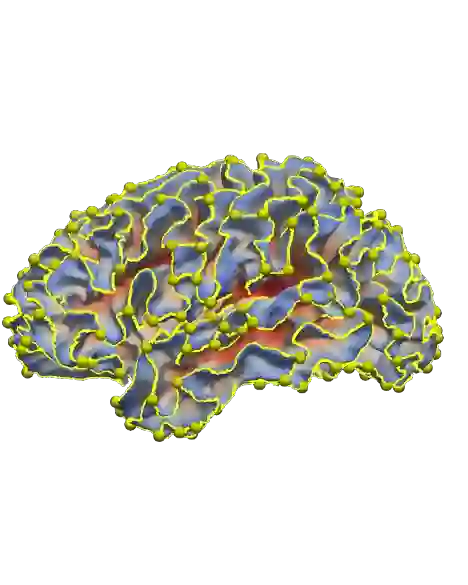
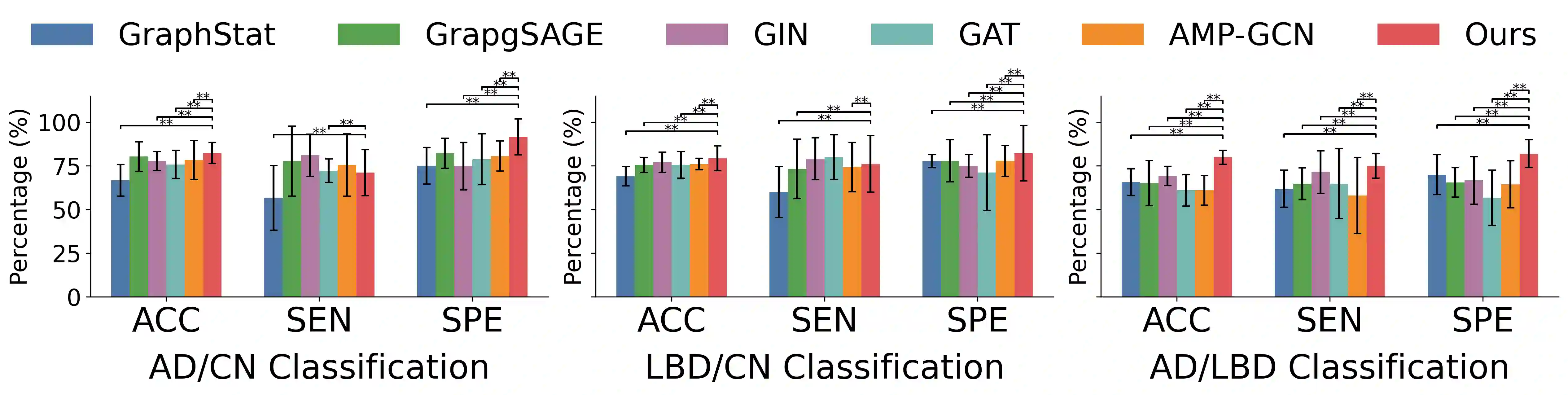
Alzheimer's disease (AD) and Lewy body dementia (LBD) present overlapping clinical features yet require distinct diagnostic strategies. While neuroimaging-based brain network analysis is promising, atlas-based representations may obscure individualized anatomy. Gyral folding-based networks using three-hinge gyri provide a biologically grounded alternative, but inter-individual variability in cortical folding results in inconsistent landmark correspondence and highly irregular network sizes, violating the fixed-topology and node-alignment assumptions of most existing graph learning methods, particularly in clinical datasets where pathological changes further amplify anatomical heterogeneity. We therefore propose a probability-invariant random-walk-based framework that classifies individualized gyral folding networks without explicit node alignment. Cortical similarity networks are built from local morphometric features and represented by distributions of anonymized random walks, with an anatomy-aware encoding that preserves permutation invariance. Experiments on a large clinical cohort of AD and LBD subjects show consistent improvements over existing gyral folding and atlas-based models, demonstrating robustness and potential for dementia diagnosis.
翻译:阿尔茨海默病(AD)与路易体痴呆(LBD)具有重叠的临床特征,但需要不同的诊断策略。虽然基于神经影像的脑网络分析具有前景,但基于图谱的表征可能模糊个体化解剖结构。利用三铰链脑回构建的脑回折叠网络提供了生物学基础更坚实的替代方案,但皮层折叠的个体间差异会导致标志点对应关系不一致及网络规模高度不规则,这违背了现有大多数图学习方法对固定拓扑和节点对齐的假设——在临床数据集中,病理变化会进一步放大解剖异质性。为此,我们提出一种基于概率不变随机游走的框架,该框架无需显式节点对齐即可对个体化脑回折叠网络进行分类。皮层相似性网络基于局部形态测量特征构建,并通过匿名随机游走的分布进行表征,其中采用保持置换不变性的解剖感知编码。在大型AD与LBD临床队列上的实验表明,本方法相较于现有脑回折叠模型及基于图谱的模型均取得稳定改进,展现了其在痴呆诊断中的鲁棒性与应用潜力。




相关内容



 微信扫码咨询专知VIP会员