

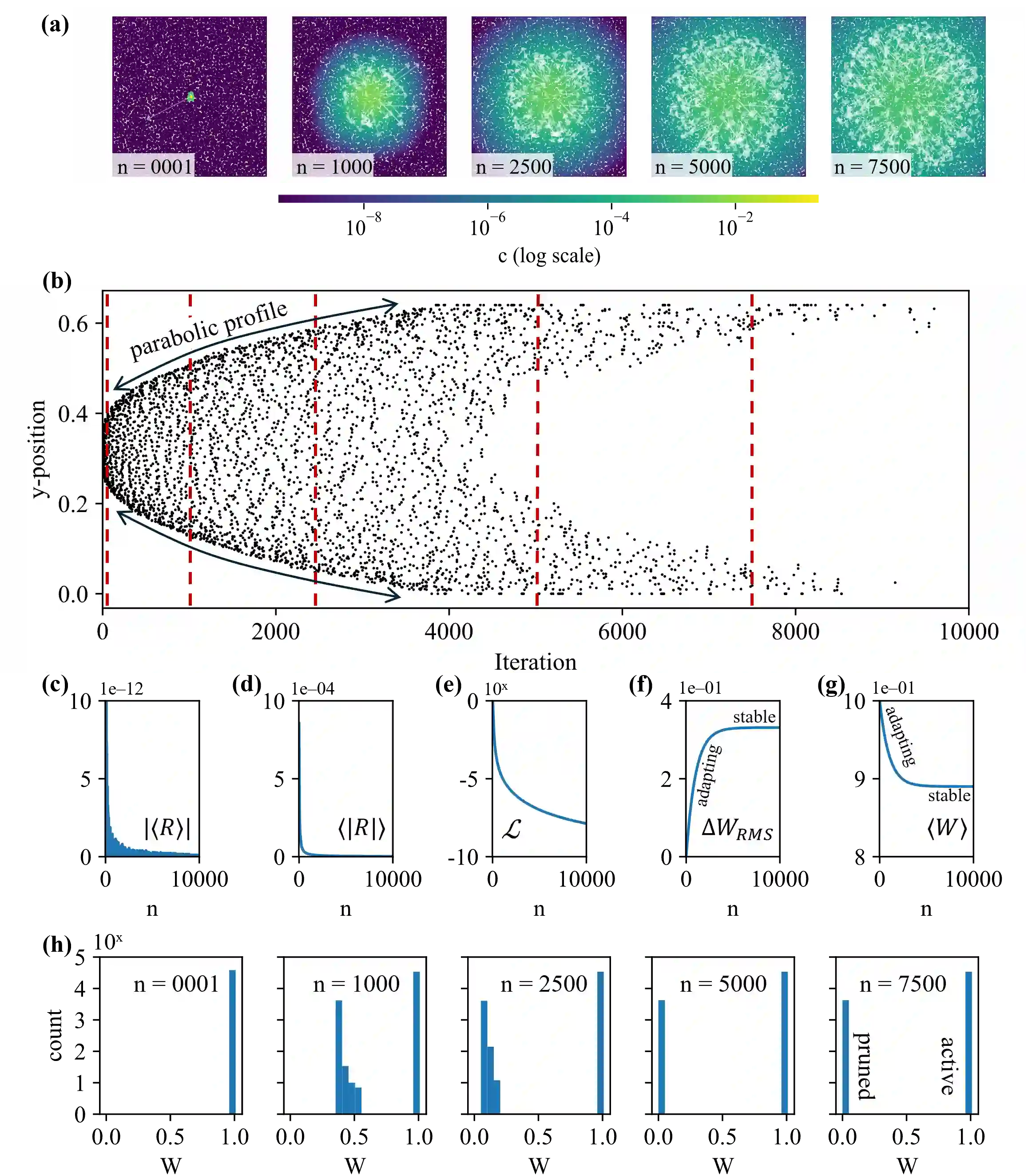
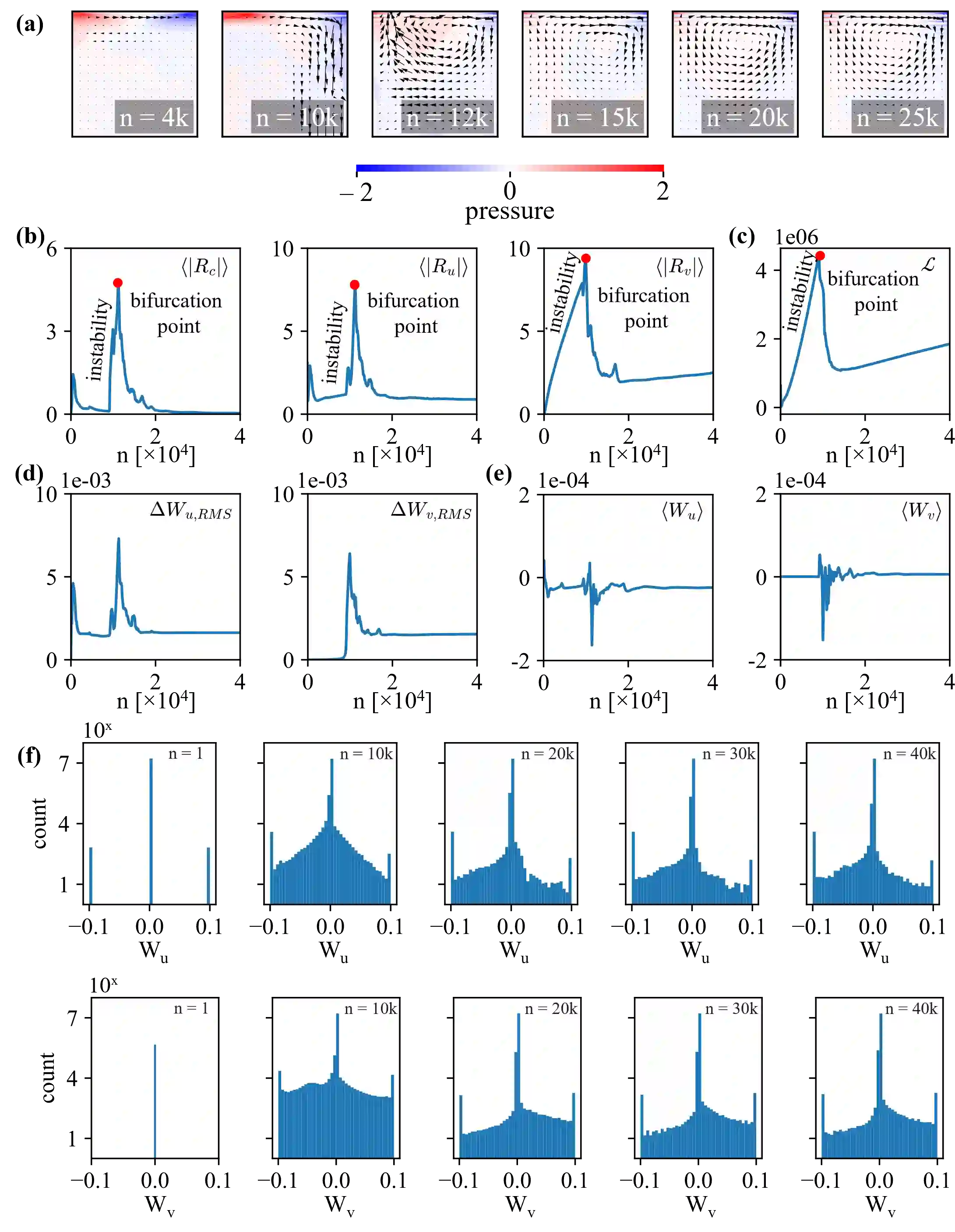
Physical transport processes organize through local interactions that redistribute imbalance while preserving conservation. Classical solvers enforce this organization by applying fixed discrete operators on rigid grids. We introduce the Hebbian Physics Network (HPN), a computational framework that replaces this rigid scaffolding with a plastic transport geometry. An HPN is a coupled dynamical system of physical states on nodes and constitutive weights on edges in a graph. Residuals--local violations of continuity, momentum balance, or energy conservation--act as thermodynamic forces that drive the joint evolution of both the state and the operator (i.e. the adaptive weights). The weights adapt through a three-factor Hebbian rule, which we prove constitutes a strictly local gradient descent on the residual energy. This mechanism ensures thermodynamic stability: near equilibrium, the learned operator naturally converges to a symmetric, positive-definite form, rigorously reproducing Onsagerś reciprocal relations without explicit enforcement. Far from equilibrium, the system undergoes a self-organizing search for a transport topology that restores global coercivity. Unlike optimization-based approaches that impose physics through global loss functions, HPNs embed conservation intrinsically: transport is restored locally by the evolving operator itself, without a global Poisson solve or backpropagated objective. We demonstrate the framework on scalar diffusion and incompressible lid-driven cavity flow, showing that physically consistent transport geometries and flow structures emerge from random initial conditions solely through residual-driven local adaptation. HPNs thus reframe computation not as the solution of a fixed equation, but as a thermodynamic relaxation process where the constitutive geometry and physical state co-evolve.
翻译:物理输运过程通过局部相互作用自组织形成,这些作用重新分配不平衡性同时保持守恒性。经典求解器通过在刚性网格上应用固定离散算子来强制实现这种组织。我们提出赫比物理网络(HPN),这是一种用可塑性输运几何取代刚性框架的计算框架。HPN是由图中节点上的物理状态与边上的本构权重耦合而成的动力系统。残差——连续性、动量平衡或能量守恒的局部破坏——作为热力学驱动力,驱动状态和算子(即自适应权重)的联合演化。权重通过三因子赫比规则进行自适应调整,我们证明该规则构成了对残差能量的严格局部梯度下降。该机制确保了热力学稳定性:在平衡态附近,学习到的算子自然收敛于对称正定形式,无需显式约束即可严格再现昂萨格倒易关系。在远离平衡态时,系统通过自组织搜索恢复全局强制性的输运拓扑。与通过全局损失函数施加物理约束的基于优化的方法不同,HPN将守恒性内在地嵌入其中:输运通过演化算子本身在局部恢复,无需全局泊松求解或反向传播目标函数。我们在标量扩散和不可压缩盖驱动腔流问题上验证了该框架,结果表明物理一致的输运几何和流动结构仅通过残差驱动的局部自适应从随机初始条件中涌现。因此,HPN将计算重新定义为非固定方程的求解,而是本构几何与物理状态协同演化的热力学弛豫过程。




相关内容


 微信扫码咨询专知VIP会员